Home Page | Blog | Make Your Dining Area Look Classic
Make Your Dining Area Look Classic
8/4/2026
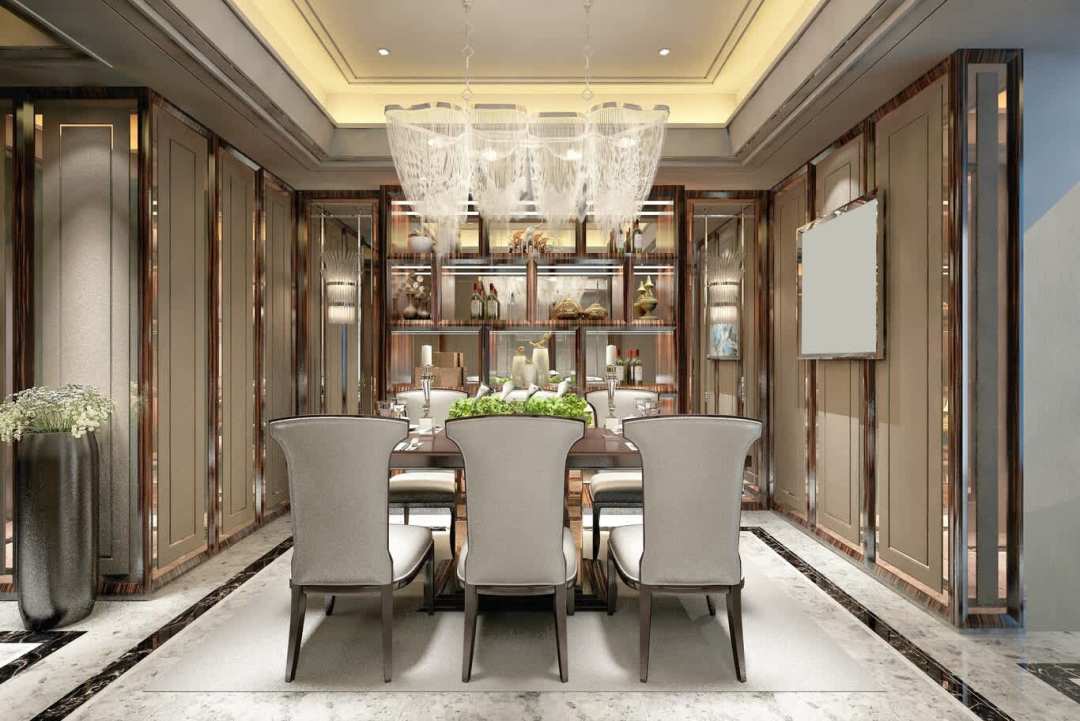
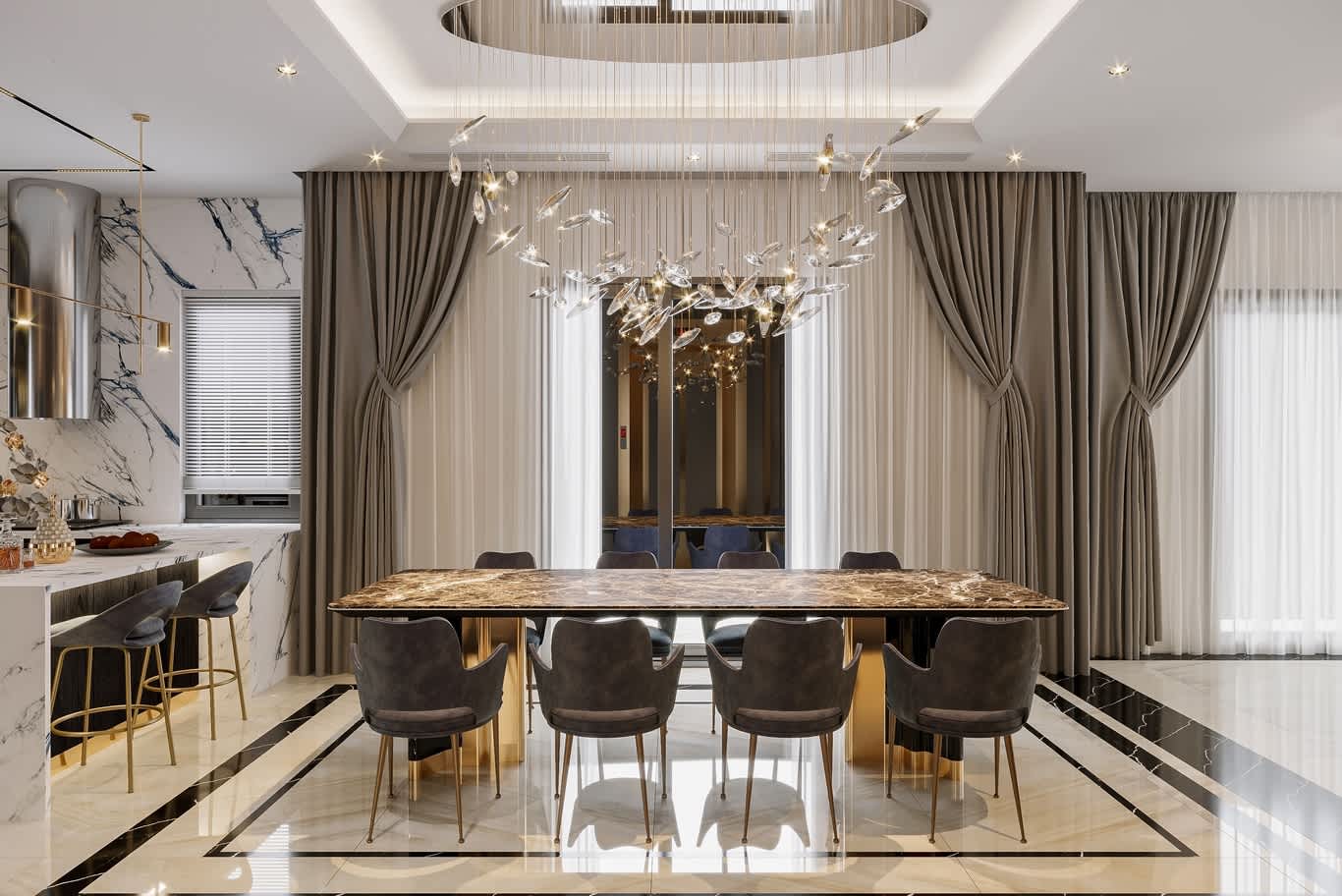
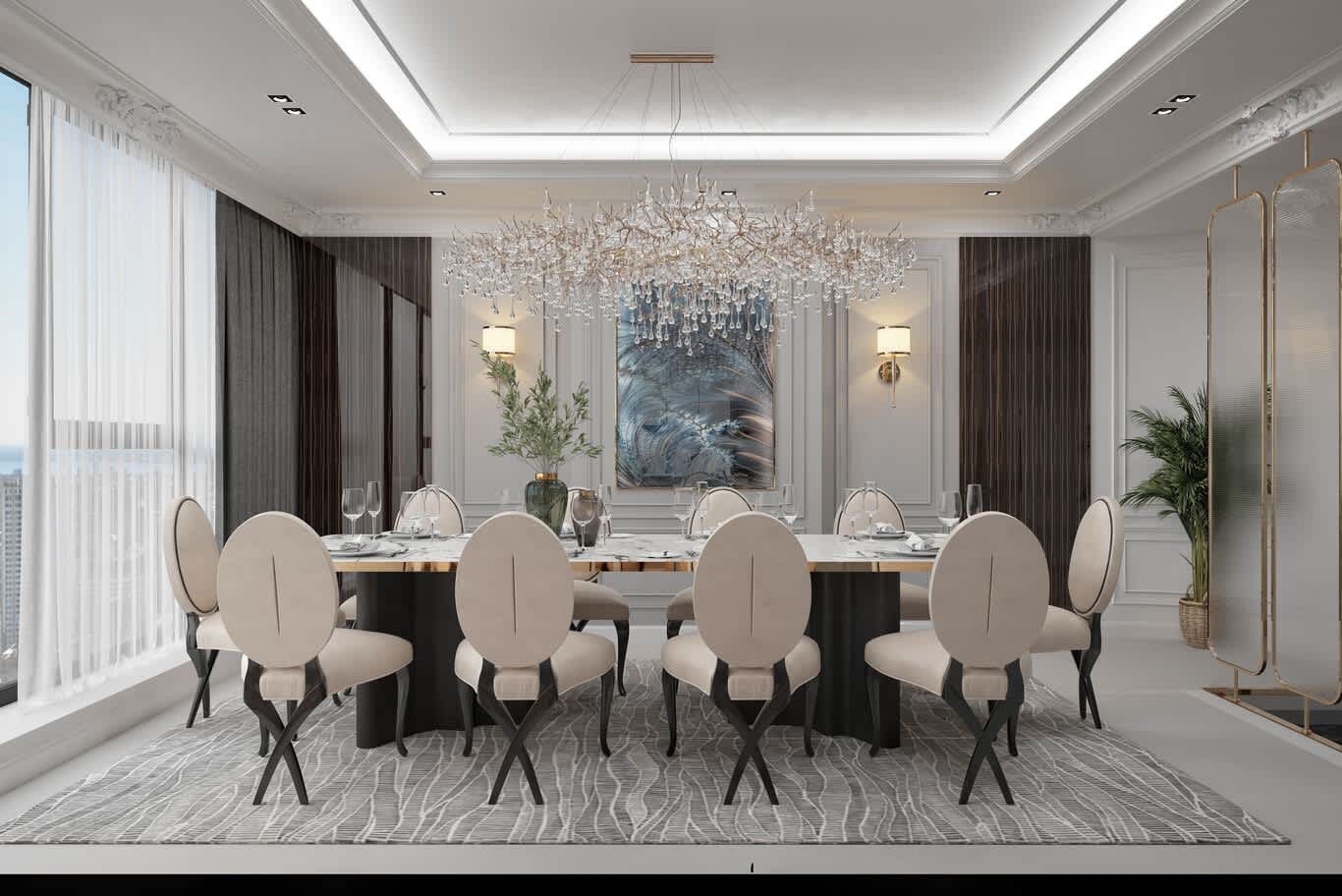
A classic dining room earns its authority slowly, through proportion, material and the confidence to leave a wall bare. Algedra's designers have spent years refining that balance across residential projects in Dubai and the wider Gulf, and our light classic villa shows the approach at full scale: a long table under a single generous chandelier, panelled walls in soft cream, drapery heavy enough to hold the light. What follows are the principles behind rooms like it, translated for a home of any size.
1- Begin with the table, and let the room follow
Every decision in a classic dining room descends from the table. Solid timber remains the standard — walnut, oak or mahogany in a polished finish, with carved or turned legs that reward a second look.
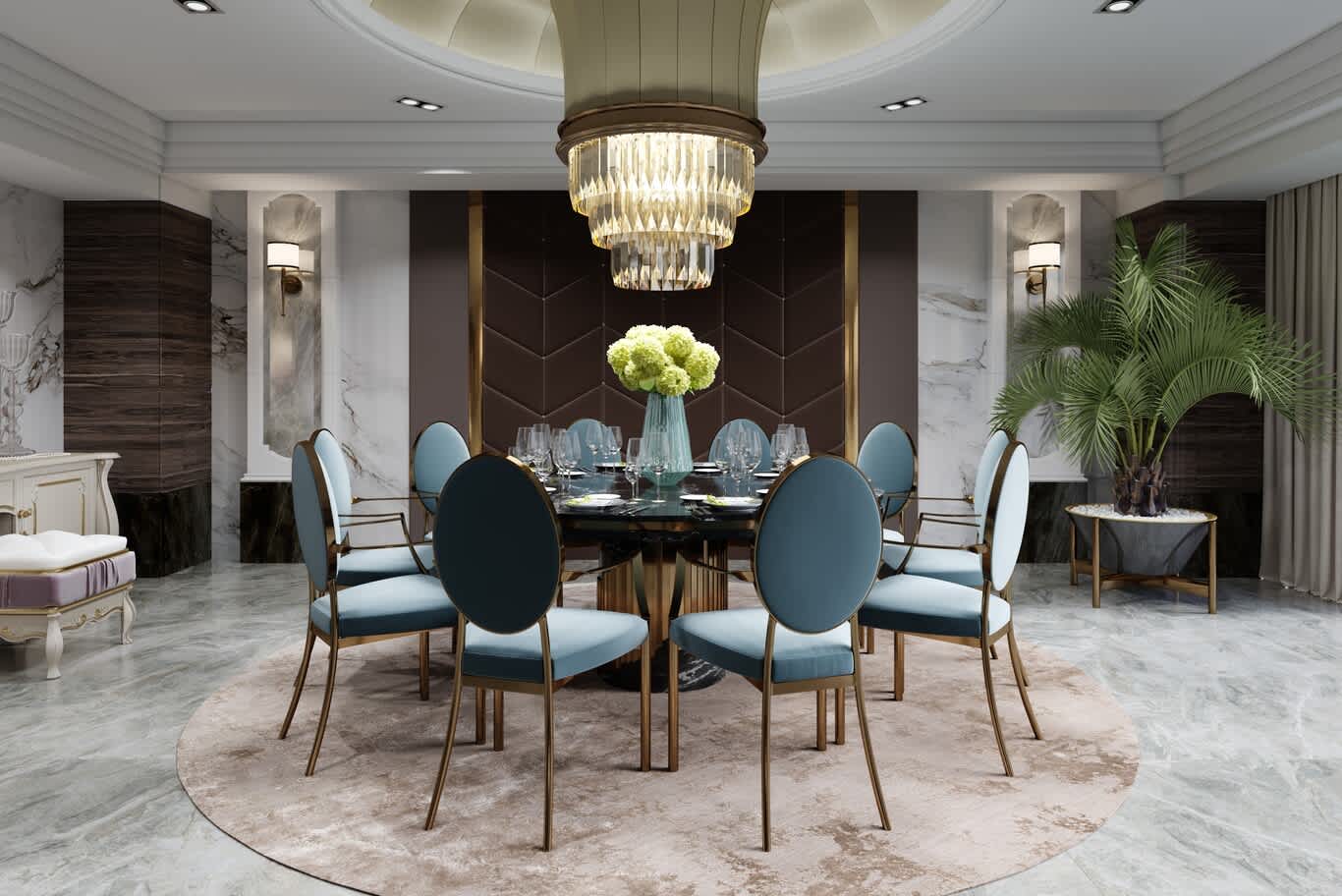
For a narrow apartment serving a large family, a round table in wood and glass keeps circulation open and seats more people than its footprint suggests. Generous rooms take a rectangular table with upholstered chairs at either end, the arrangement symmetrical and deliberate. Allow around a metre of clearance on every side so chairs pull back cleanly.
2- Chairs, and the pair that ends the table
Side chairs and carvers work together in the classic tradition: matching seats down the length, armed chairs at the two ends to mark the axis. The carvers may differ in upholstery or finish, and that small variation gives the arrangement its formality.
A seat height of 45 centimetres against a 75-centimetre table gives the clearance a diner needs. Upholster in velvet, brocade or close-woven linen, and specify a removable seat pad — the one detail that lets a classic chair survive a decade of family use.
3- A palette built on beige, off-white and warm brown
Classic interiors reward restraint in colour and generosity in texture. Off-white walls, beige upholstery, brown timber and a carpet that sits between the two produce depth that reads as considered.
White curtains earn their place here. They soften the perimeter, admit the light a dining room needs at midday, and give the eye somewhere quiet to rest between the chandelier and the table.
4- Gold and black for the rooms that can carry it
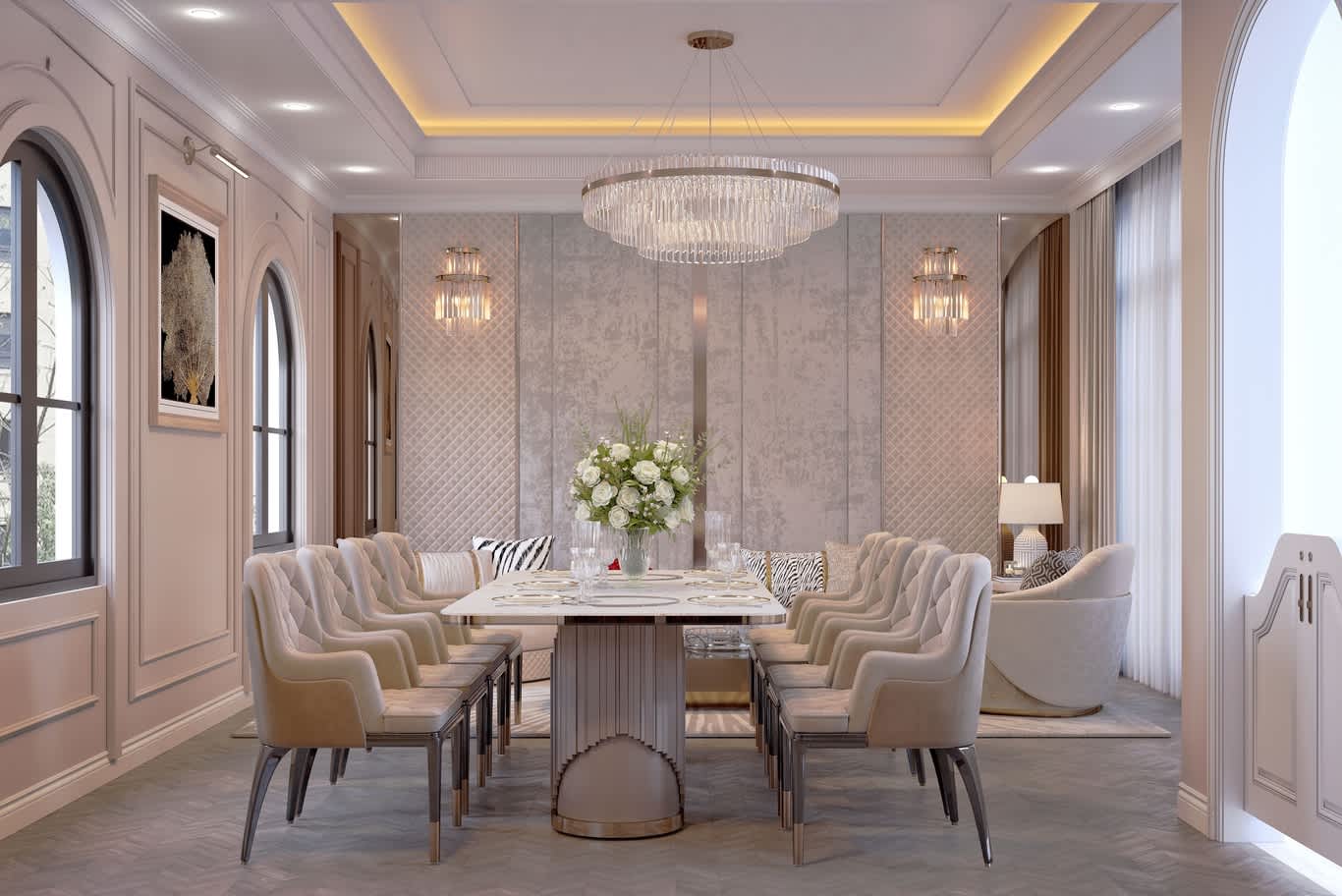
A black-and-gold scheme suits high ceilings and long sightlines. Gilded mirror frames, brass chair detailing, black doors set against pale walls — each element sharpens the outline of the room and gives the whiteness a defined edge.
Handmade gold accessories, commissioned from craftsmen rather than bought in sets, carry the weight of this palette. Three or four pieces achieve more than a dozen.
5- Deeper palettes for evening rooms
Rooms used mainly after dark take a stronger colour well. Deep green, oxblood and a warm charcoal all belong to the classic tradition, and each holds candlelight in a way pale walls cannot.
Keep the ceiling light and the trim in a related tone, and let the timber and gold carry through unchanged. The scheme then shifts in mood while the architecture stays exactly as it was.
6- The glass cabinet remains essential
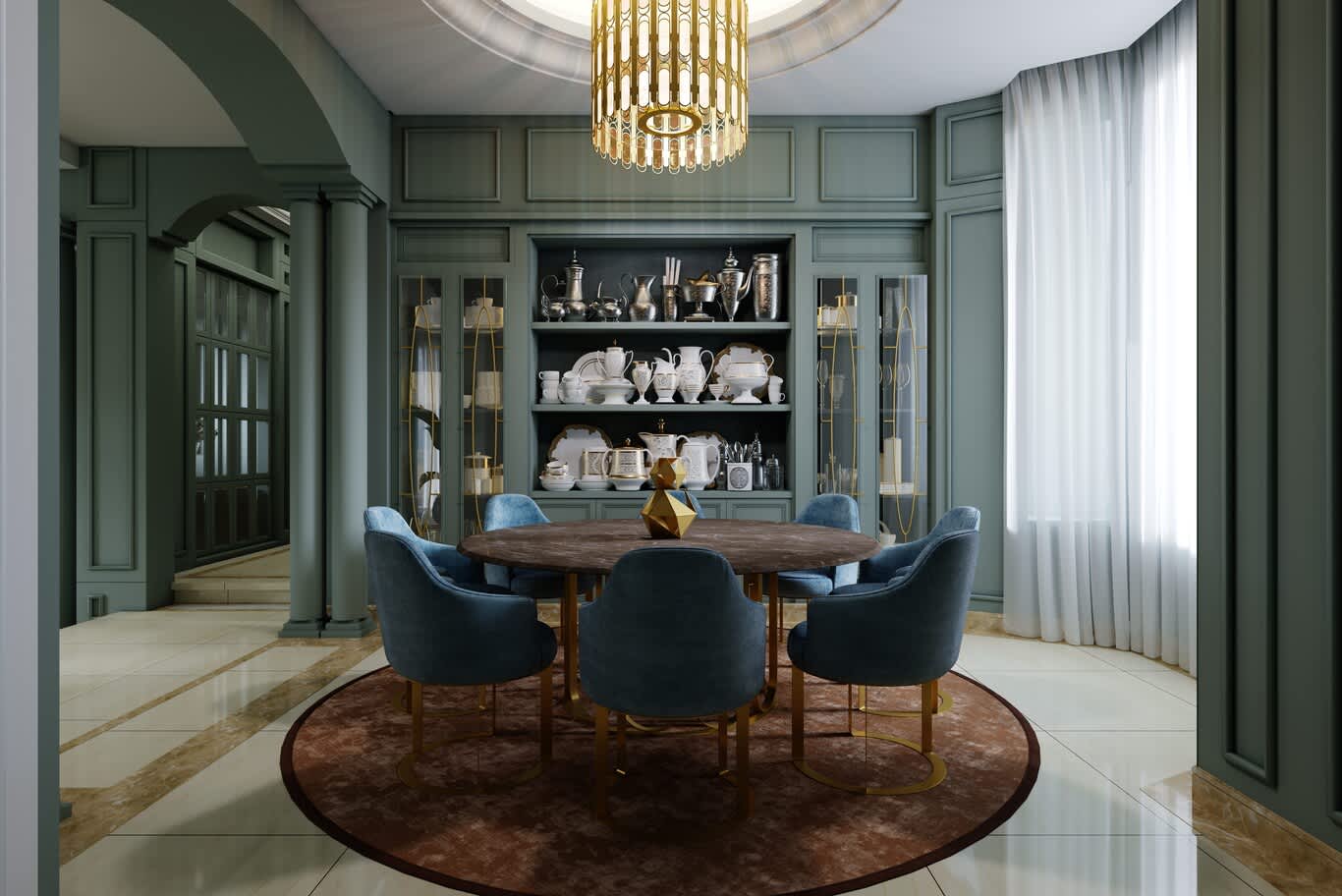
A glazed display cabinet beside the sideboard is the detail that separates a classic dining room from a contemporary one. It holds crystal goblets, fine china and silver, and it turns tableware into part of the scheme.
Edit what goes inside. Space between pieces lets each one register; a crowded shelf reduces the whole display to pattern. Rotate the contents seasonally and keep the lower shelves for the plates you actually use.
7- Lighting sets the hierarchy
One chandelier, centred over the table, hung roughly 75–85 centimetres above the surface. Crystal or candelabra styles suit the register, and the fixture should measure around half to two-thirds the table's width so it holds the centre without crowding it.
Wall sconces on the flanking walls, dimmable, handle the evening. Candles handle the rest.
8- Three lighting scenes, on dimmers
A dining room needs bright light for setting the table, moderate light for a family meal, and low light for the hours after dessert. Put every circuit on a dimmer at the design stage, since retrofitting one is far more disruptive than specifying it.
Warm lamps throughout — 2700K and no higher. Cool light flattens gilding, greys warm timber and drains the colour from food.
9- Ornament, applied with discipline
Classic design succeeds through quality of line and material. Chairs and tables with simple silhouettes, paired with one genuinely luxurious chandelier, achieve an elegance that heavy carving throughout the room tends to obscure. Wall panelling, a single large mirror above the sideboard, and a well-chosen centrepiece complete the composition.
10- Wall panelling and the ceiling above it
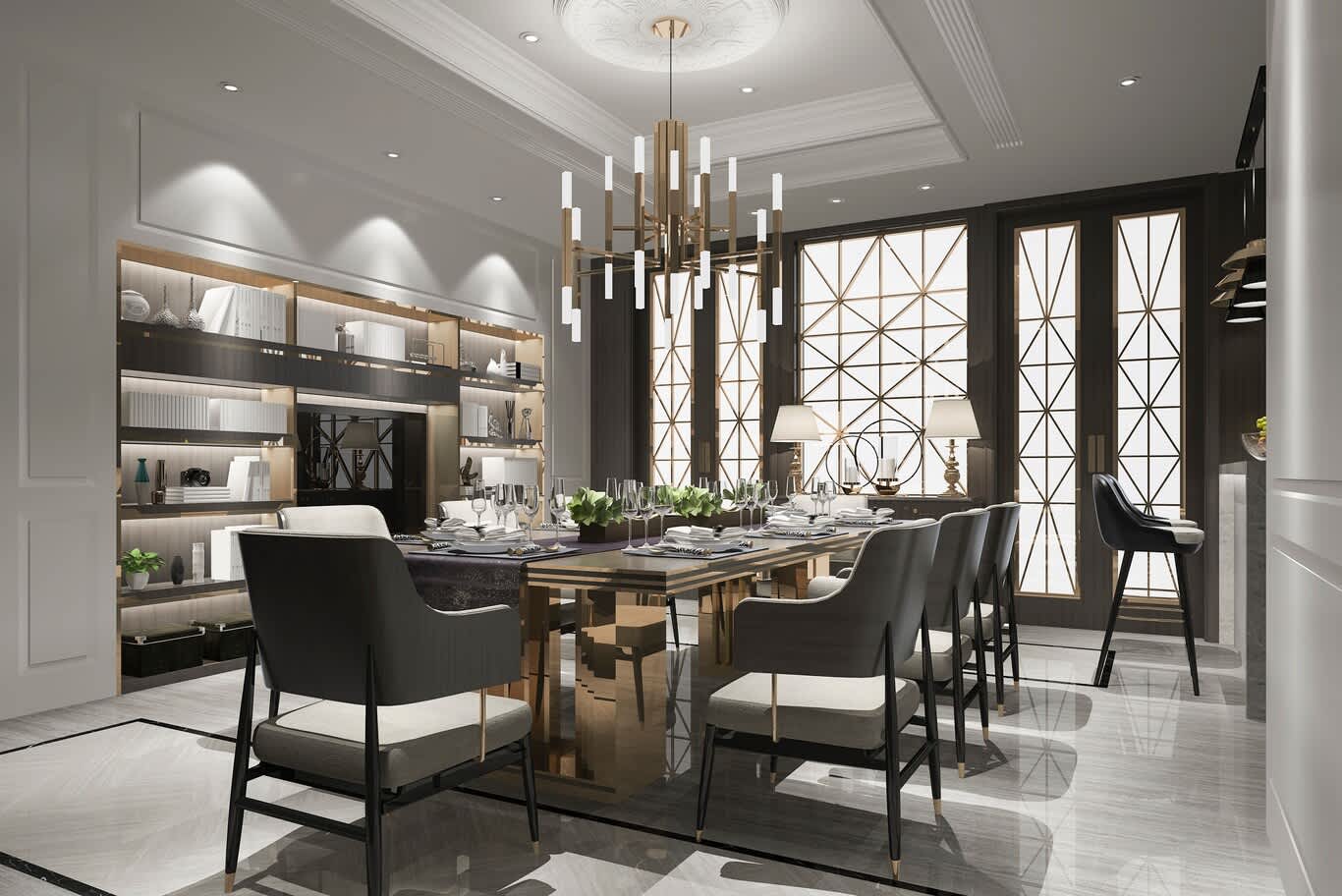
Panelling gives a classic dining room its architecture. Full-height panels suit ceilings above three metres; a dado with a moulded rail suits standard heights and leaves the upper wall free for a mirror or a single large canvas.
Paint the panelling and the wall behind it the same colour, so the relief registers as shadow. The ceiling deserves equal attention — a cornice, a central rose beneath the chandelier, and a shade one step lighter than the walls to lift the whole room.
11- Cornice, skirting and architrave
The mouldings decide whether a classic room convinces. A cornice too shallow for the ceiling height, or a skirting under 15 centimetres, undermines an otherwise correct scheme faster than any furniture choice.
Scale them together: taller rooms take a deeper cornice and a taller skirting, with the architrave sized to match. Plaster holds a crisper profile than MDF and takes paint better, and in a room this visible it repays the difference.
12- The rug, sized correctly
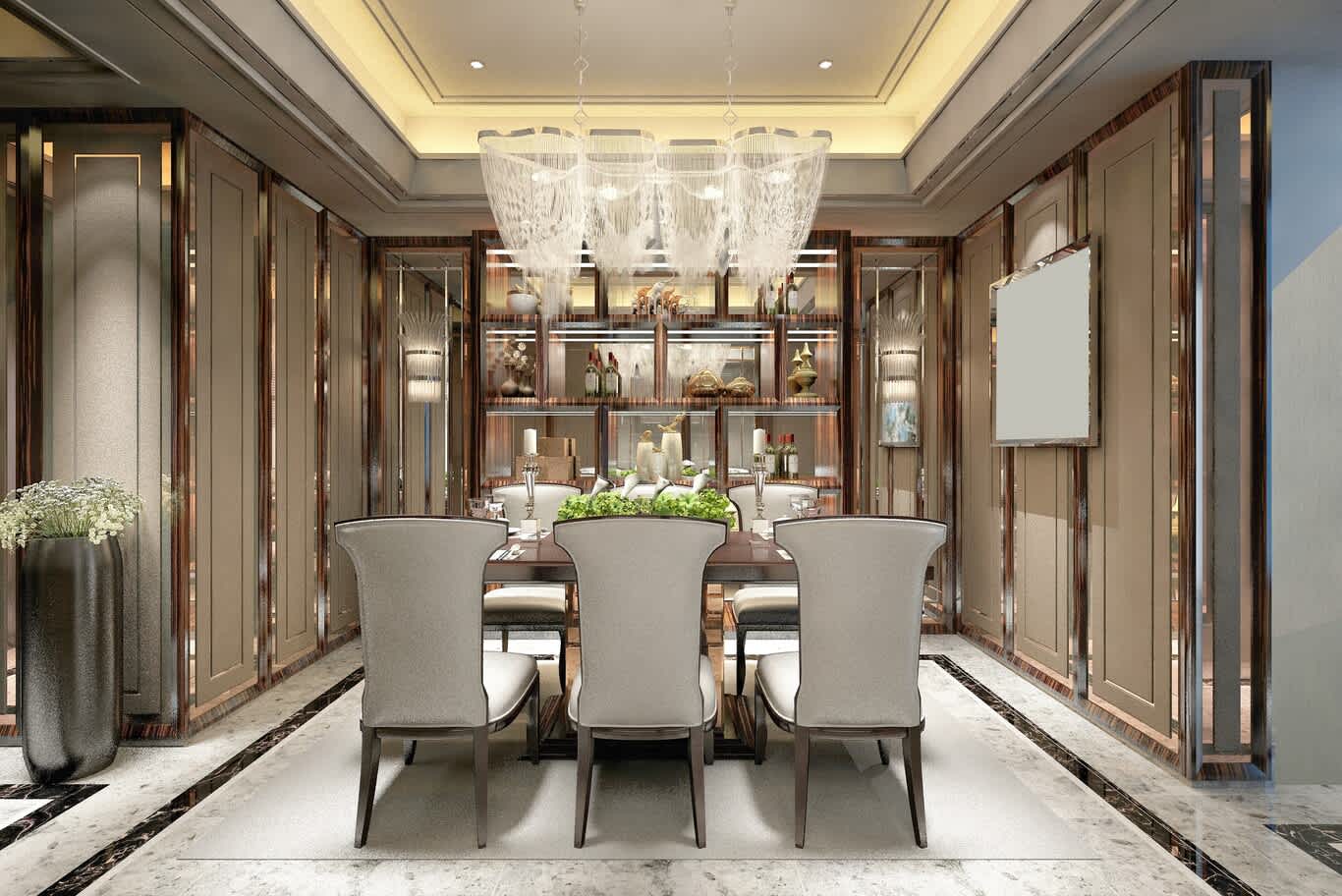
A dining rug should extend at least 60 centimetres beyond the table on every side, so chair legs stay on the pile when pulled back. Anything smaller catches the chairs and unsettles the room each time someone sits down.
Wool holds up to a dining room's traffic and spills better than silk blends. Keep the pattern quiet — a subtle border or an all-over ground in beige and brown supports the scheme rather than competing with the table.
13- Flooring underneath
Timber parquet in a herringbone or chevron set remains the classic choice, and its diagonal geometry adds movement beneath a static arrangement of furniture. Marble suits Gulf villas particularly well, holding the cool of the room and reflecting the chandelier.
Whichever surface you choose, run it continuously into the adjoining hall. A change of material at the threshold shrinks both rooms.
14- Window treatments beyond the curtain
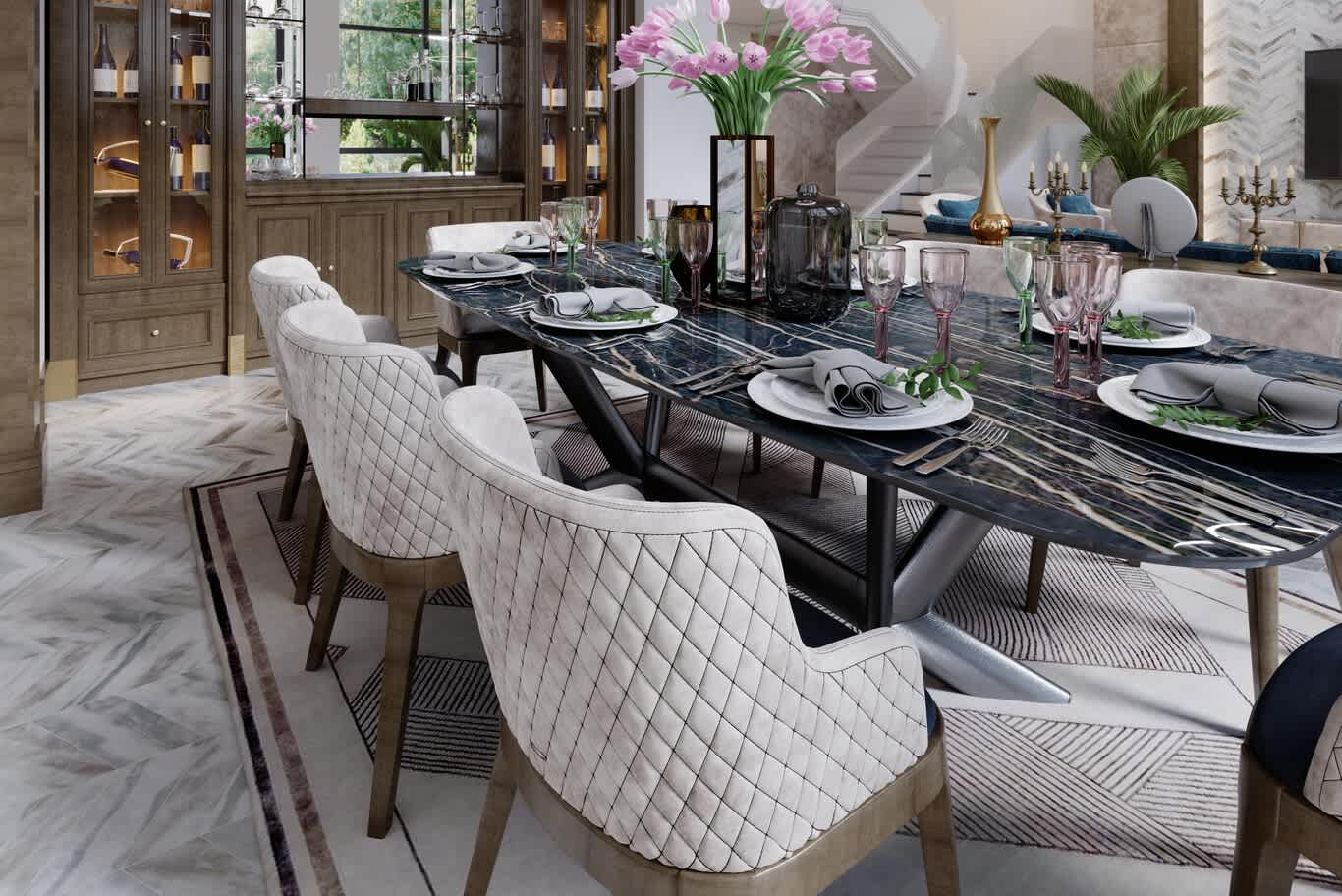
Full-length drapery, hung from the ceiling line and breaking gently on the floor, is the foundation. Layer a sheer beneath it for daytime privacy and a softened light through the hottest hours.
Pinch pleat and goblet headings both belong to the classic register; the goblet heading in particular reads as formal and holds its shape across years of use. Add pelmets in high rooms to finish the top of the window with the same discipline as the skirting finishes the bottom.
15- Art and mirrors
One large mirror above the sideboard extends the room, doubles the chandelier and returns whatever daylight the curtains admit. An ornate gilt frame suits a gold scheme; a simpler moulded frame in a painted finish suits a beige one.
For art, choose fewer and larger. A single still life, landscape or portrait at a generous scale carries more authority than a gallery wall, and it keeps the room's few objects in proper hierarchy.
16- Setting the table
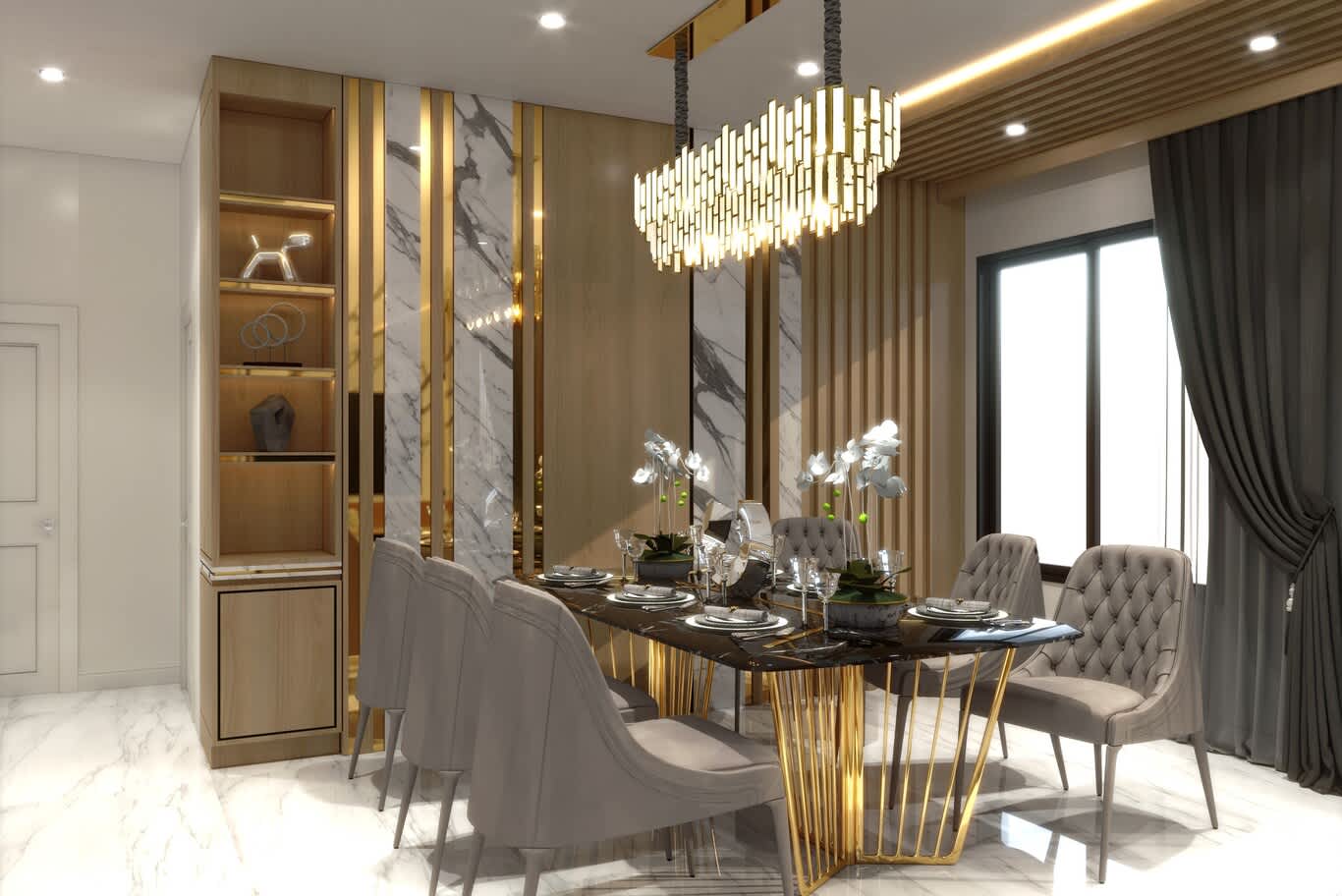
The table itself is part of the design, and a classic dining room looks best when it stays partly dressed. Fine china, crystal glasses and silver cutlery are the traditional components, and even a permanent setting of chargers and folded linen keeps the surface composed between meals.
A centrepiece anchors the axis. Low floral arrangements, a pair of candlesticks or a single sculptural bowl all work — anything under 30 centimetres in height so guests can see one another across the table.
17- Table linen through the seasons
Damask and heavy cotton belong to the formal end of the classic tradition, and a full cloth transforms an everyday table for a gathering. Runners and placemats suit a table whose timber deserves to stay visible.
Keep two sets: cream or white for most of the year, and something deeper in tone for winter meals and Ramadan evenings. Press and store them flat, since a folded crease reads on camera and across a room.
18- Storage that stays out of sight
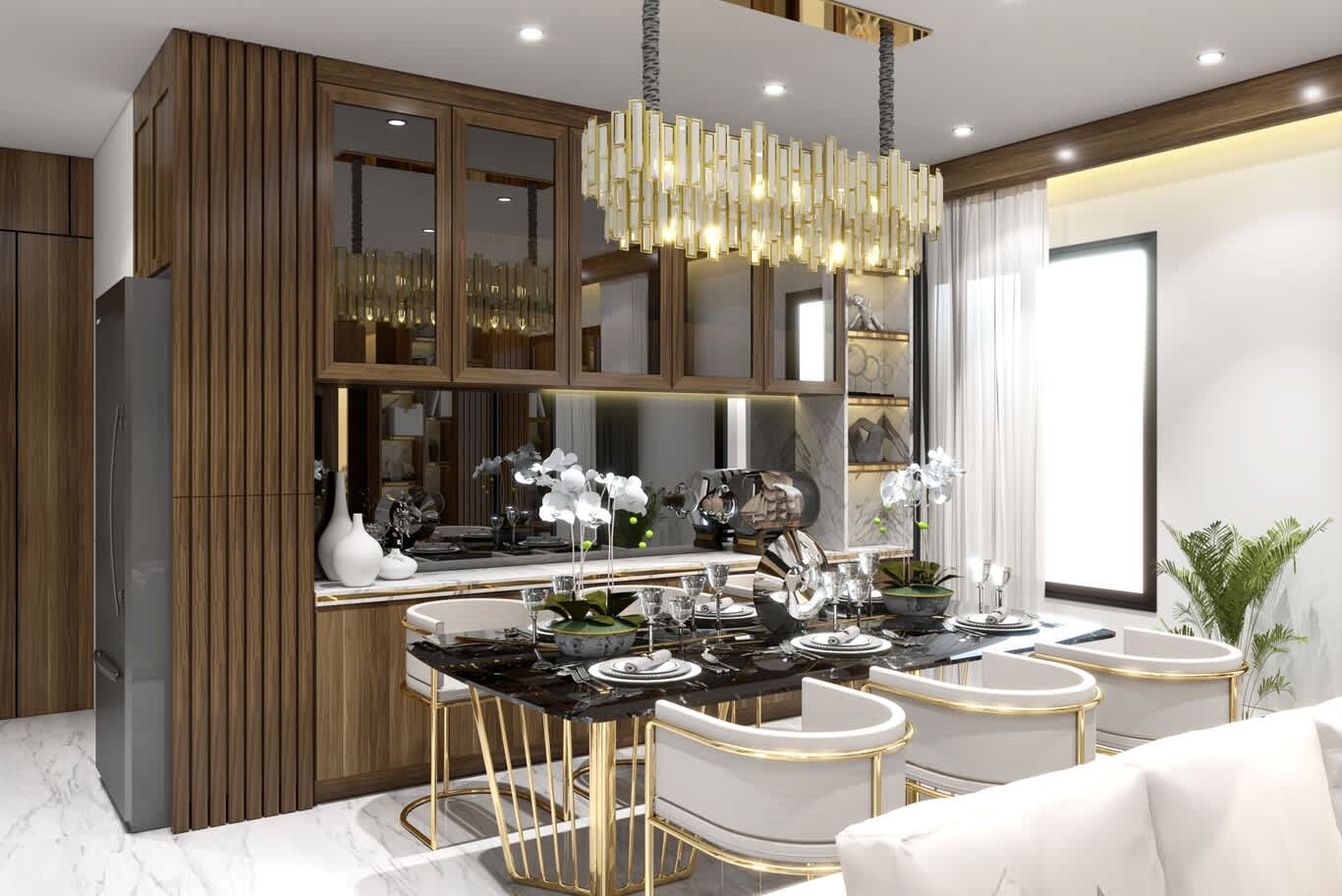
The sideboard handles linen, cutlery and serving dishes, and its top becomes the surface for coffee and dessert. Choose one roughly two-thirds the length of the table for a proportion that reads as intentional.
Where the room allows, joinery built into an alcove offers deeper storage with a fully classic face — panelled doors, brass hardware, a marble top. It absorbs everything a dining room accumulates and gives back a flush, quiet wall.
19- Classic dining in an open plan
Villas across the UAE increasingly place dining within a single continuous space alongside the living room and kitchen. The classic register still works here, provided the dining zone is defined: the rug marks its boundary, the chandelier marks its centre, and a console or a pair of tall cabinets marks its edge.
Keep the timber tones and the metal finishes consistent across the whole space so the three zones read as one home rather than three schemes.
20- The formal room and the family table
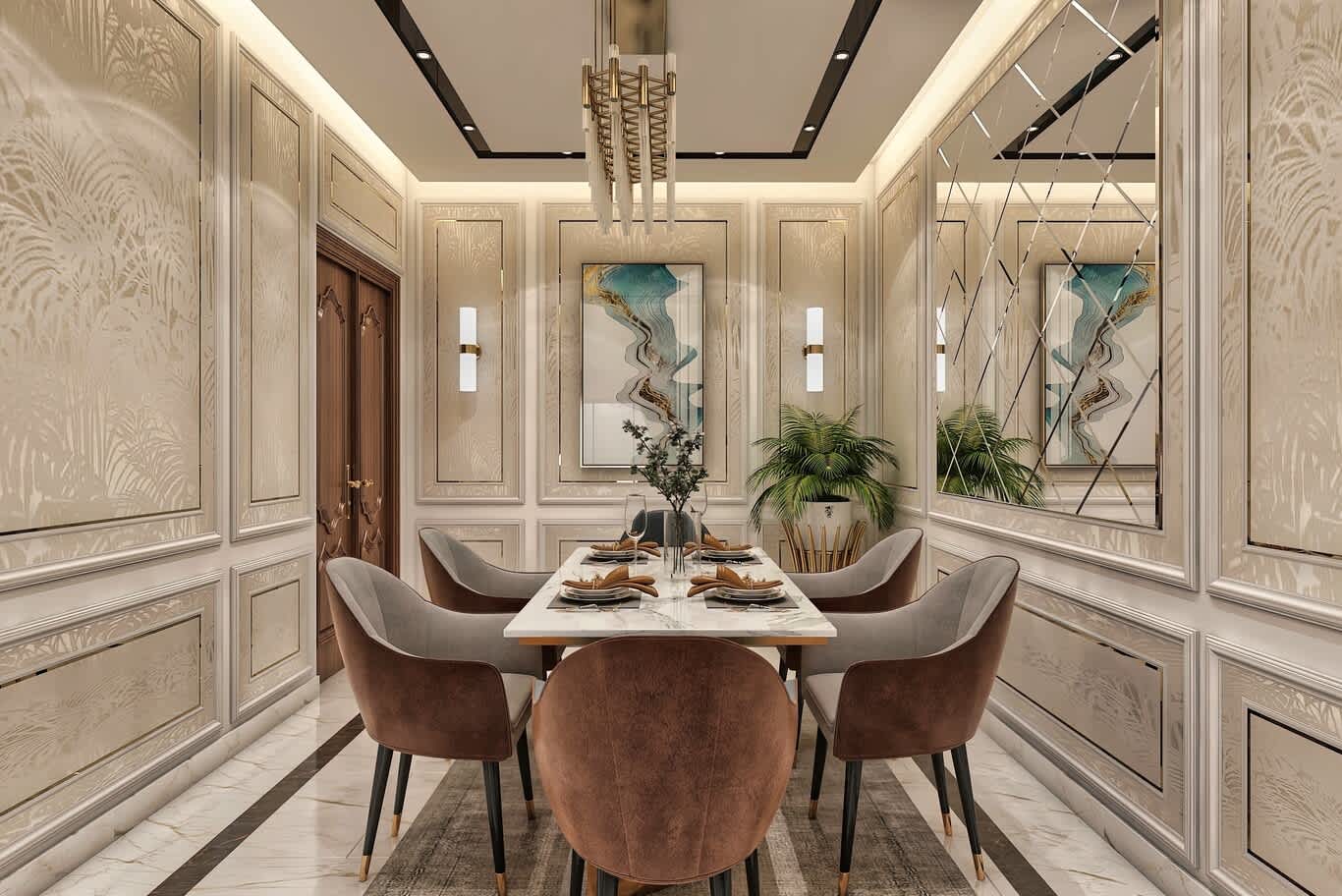
Larger Gulf villas often run two dining spaces: a formal room for guests and a smaller table beside the kitchen for daily meals. Each takes a different weight — the formal room panelled, chandeliered and fully dressed, the family table simpler in silhouette and more forgiving in finish.
Link them through material rather than through matching furniture. Shared timber tones, a repeated metal finish and a consistent floor keep both rooms within one house.
21- Acoustics, and why the room sounds better dressed
Hard floors, glazed cabinets and a large timber table make a lively acoustic, and conversation across ten seats suffers for it. Every soft element in the scheme is also doing acoustic work.
Lined drapery, a wool rug, upholstered seats and fabric-backed panelling together absorb enough to let people talk comfortably at either end of the table. This is one of the quieter arguments for full-length curtains in a room that faces a courtyard rather than a street.
22- Ventilation and the practical layer
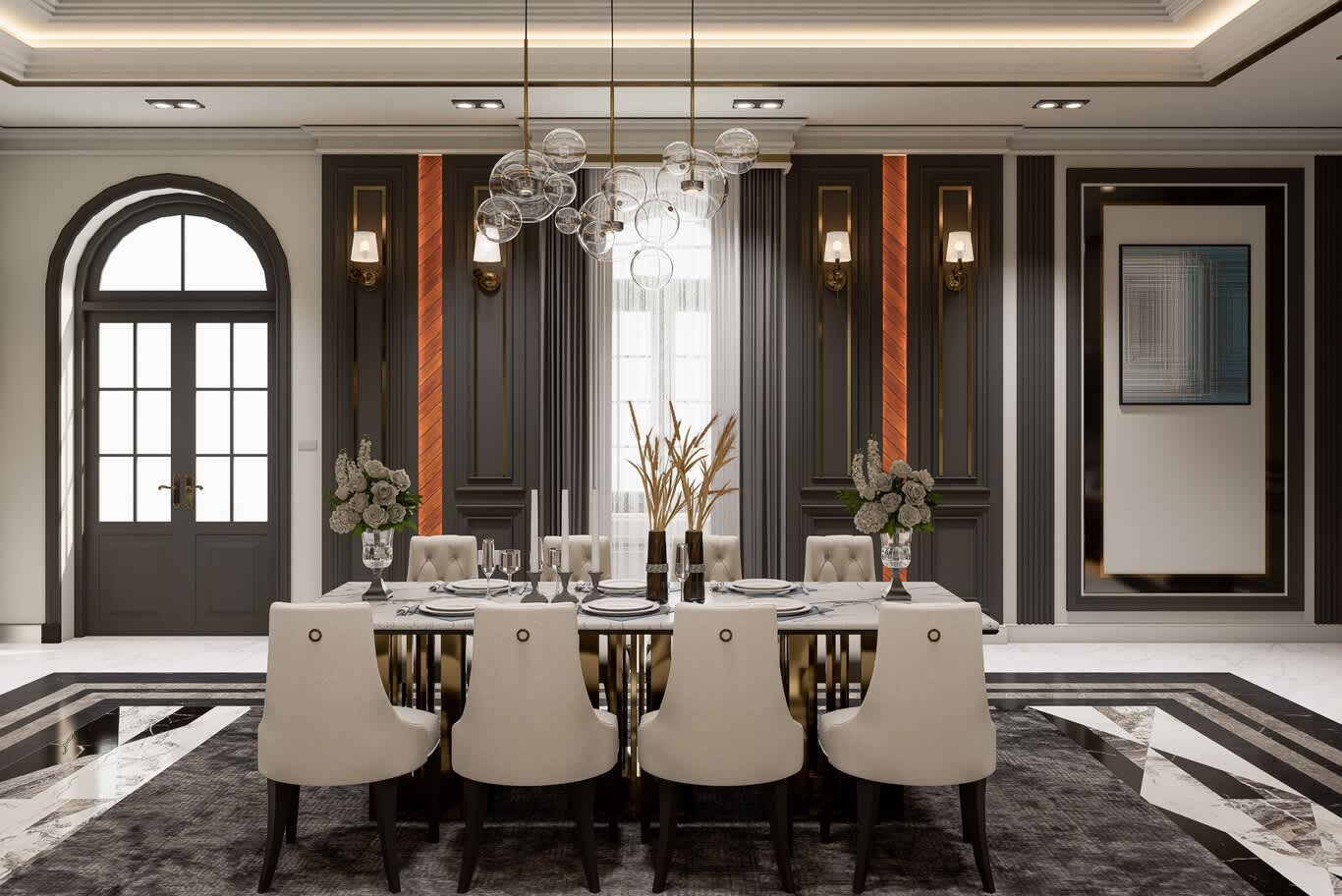
A dining room adjacent to a kitchen needs extraction that actually works, or the drapery holds the smell of every meal. Specify the kitchen hood generously and keep the connecting door solid rather than glazed.
Air conditioning outlets deserve equal thought. Position diffusers away from the seating so cold air falls into circulation space, and detail them into the cornice line so they disappear into the architecture.
23- Common missteps
Undersized chandeliers, undersized rugs and overcrowded display cabinets account for most of what goes wrong in a classic dining room. Each one is a proportion problem rather than a taste problem, and each is fixable with a tape measure.
The fourth is quantity. A classic dining room is a room of few objects, each chosen properly, and the discipline to stop is as important as the discipline to specify well.
Where to spend, and where to hold back
Three items justify the budget: the table, the chandelier and the joinery. All three are permanent, visible from every seat, and difficult to upgrade later without disturbing the rest of the room.
Upholstery, curtains and accessories can be revisited in a decade for a fraction of the cost, and they are the natural place to hold back on a first fit-out. A classic room built on good bones tolerates a modest textile budget for years.
For a fuller account of the style's origins and how it applies across the rest of the home, our guide to classic style in interior design covers the wider principles.
Algedra designs and conceptualizes classic interiors for villas, palaces and apartments across the UAE and the Gulf. To discuss a dining room, or an entire residence, start your project with our design consultants.
FREE CONSULTATION
TELL US ABOUT YOUR PROJECT
WE WOULD LOVE TO HEAR FROM YOU
Feel free to reach us via this contact form and one of our Design Consultants will get back to you at earliest.
OUR BRANCHES
UAE - DUBAI
+971 52 8111106 | hello@algedra.ae
TURKEY - ISTANBUL
+90 533 701 89 71 | info@algedra.com.tr
Leading Interior Design and Decor Company in Dubai and Abu Dhabi.
Algedra is a reputable, internationally recognized, and one of the most successful interior design companies in Dubai, and Abu Dhabi, which specializes in delivering interior design, architectural, and creative space planning projects throughout GCC, MENA, North Africa, Turkey and Russia.
Algedra is a one-stop solution for all your residential interior design and fit-out needs. We have successfully completed numerous villa interior and exterior design projects, where we integrated quality and originality to deliver interior masterpieces.
ALGEDRA, Interior Design Company in Dubai, is specialized in providing elegant and stunning interior design services for both residential and commercial projects. We turn our clients' dreams into reality, trans- lating their tastes and needs into beautiful and functional spaces.
Since the day we were founded, we have designed and built many branded residences, resorts, hotels, multi-purpose social spaces, and palace designs with different functions and concepts by following the ever-changing design trends over the world.
A key element of our work is a fusion of different cultures and designs, combining Greek, Italian, Eastern and Western influences with British innovation.
As a team of highly qualified interior designers and engineers, Algedra offers complete architectural services from mall design to corporate office design as well as the exterior design of any project based on customers' needs.
Our customers include leading names, we have completed diverse projects in hospitality, landscape, commercial, and residential designs. These projects contain cafes, restaurants, gym, villas, family sitting rooms, bedrooms, kitchens; all showcasing our company's exquisite details and high-end designs.
Residential Interior Design in Dubai
Algedra's interior designers and architects have an important mission: building villas, houses, apartments, condos, and anywhere else where you reside that will fulfill your needs while being structurally safe and sound.
Architectural Designs
There are so many details that go into designing an architectural design project. Every step of the project has been carefully considered for safety and daily comfort by Algedra's experts.
Commercial Design
Conceptualizing spaces for business, to elevate style, and to increase functionality to help enhance the bottom line of a company is vital, as well as employee comfort and interior design too. Our commercial interior designers translate client's concept in ways that are efficient, attractive and provide professional workspaces.
Fit-out Projects
Algedra Interiors delivering high-quality tailored fit-out projects that transform your villas, palaces and commercial spaces.
We're a passionate team of interior designers, architects and engineers. Every day we help clients to solve interior design problems and create engaging spaces!
Wherever you are in Kuwait, Saudi Arabia, Azerbaijan, Qatar, Morocco, Algeria, Tunisia, Libya, Egypt; don't hesitate, contact us to find out more about why we are one of the best interior design companies in Dubai and Abu Dhabi!