Home Page | Blog | How Dubai and Abu Dhabi Design the Same Villa Differently
How Dubai and Abu Dhabi Design the Same Villa Differently
8/12/2026
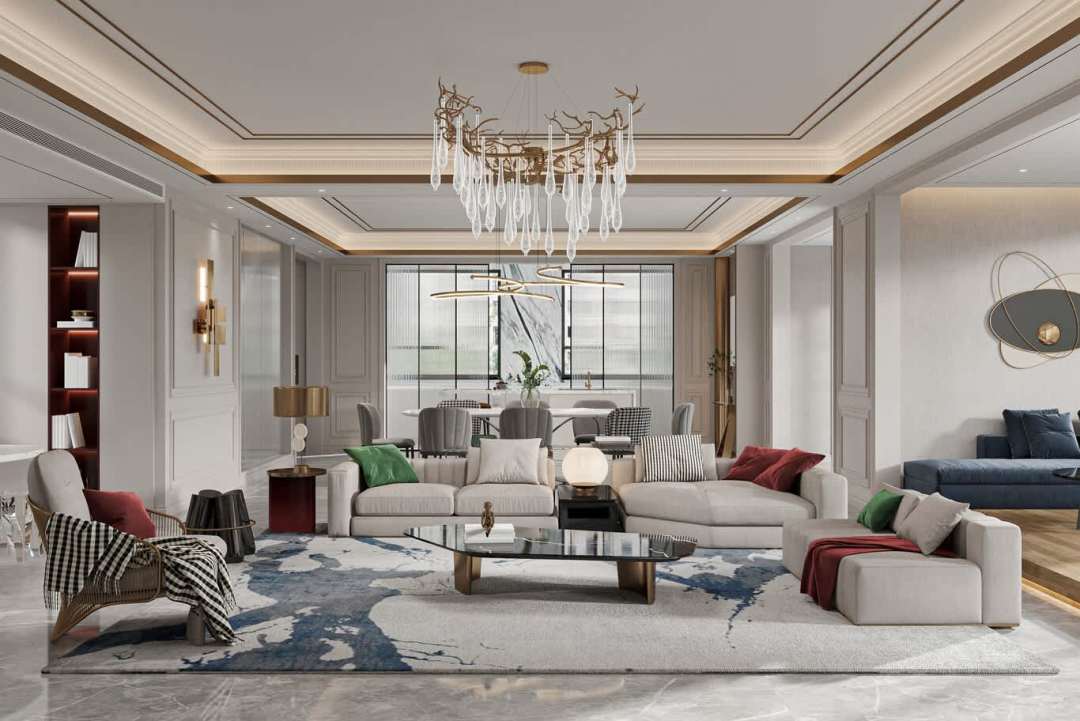
Hand the identical villa shell to our studio twice — once with a Dubai address, once with an Abu Dhabi one — and the two finished homes will be recognisably different long before anyone checks the title deed. The distance between the cities is ninety minutes on the E11; the distance between their interior philosophies is a full design brief. Dubai villas lean cosmopolitan, contemporary, and view-hungry, shaped by an international client base and a market where a home is often also an asset; Abu Dhabi villas lean classical, private, and generational, shaped by Emirati extended families for whom the house is the permanent seat of a lineage and its hospitality. Our designers and fit-out teams work both cities every week of the year, and the differences run through every layer of the work — the plan, the majlis, the palette, the ornament, the approvals, even the sequence of the site programme. The pages that follow put the two philosophies side by side, room by room and decision by decision.
Two client profiles, two definitions of home
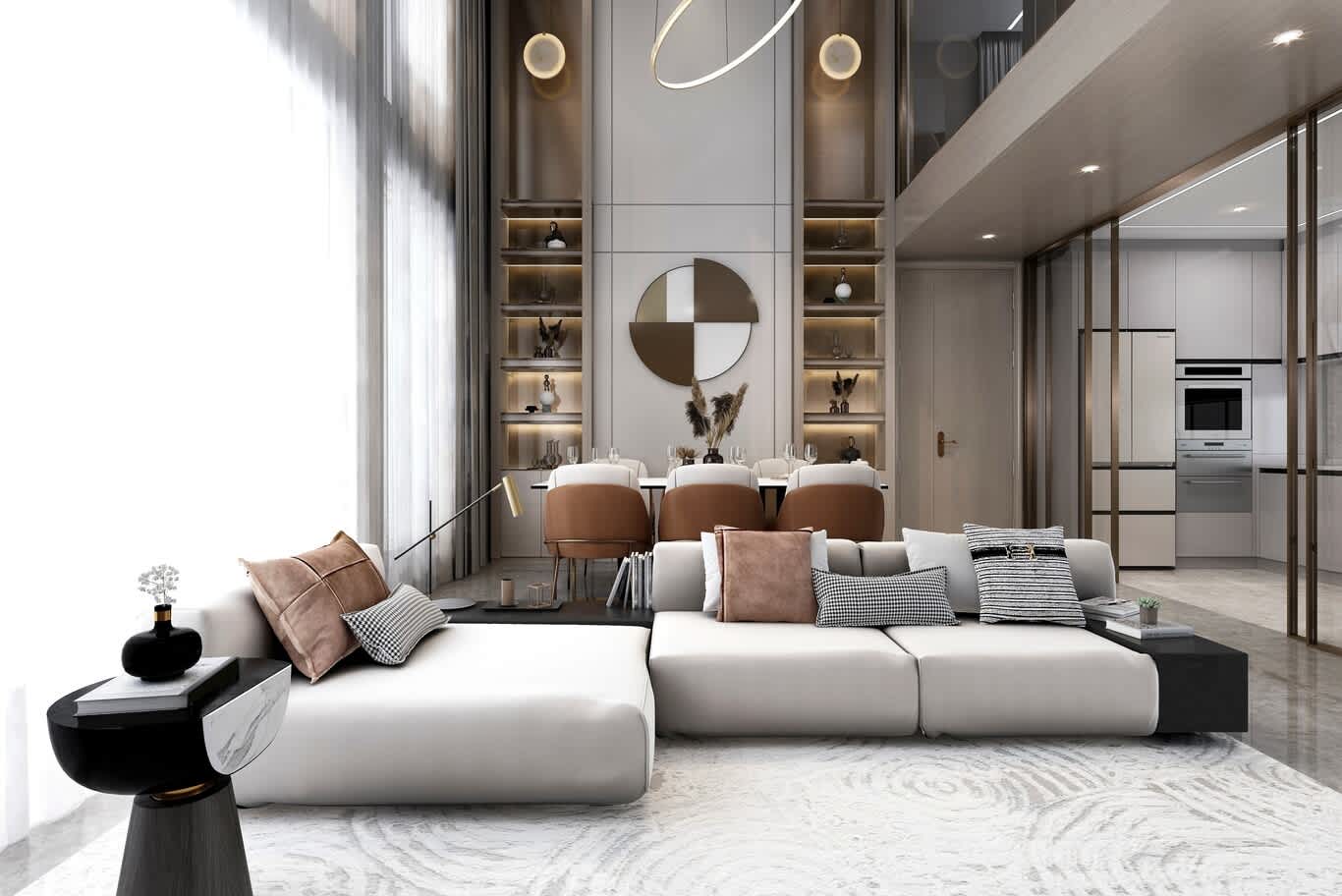
The first divergence sits in who is briefing. A Dubai villa consultation is as likely to open in English, Russian, or Mandarin as in Arabic, with clients who arrived for the city's momentum and want interiors that photograph as confidently as they live — and a meaningful share of briefs carry an investment logic, since the villa may be resold or let within a decade. An Abu Dhabi consultation is far more often held with an Emirati family designing for permanence: three generations under consideration, a plot secured for the long term, and a brief that opens with guests, privacy, and family before it reaches style. The definitions of success differ accordingly — a Dubai brief tends to ask how the villa will feel and show, an Abu Dhabi brief how it will serve and endure — and every downstream decision inherits the distinction.
The conversation that precedes the drawings
Whichever city holds the meeting, the outcome depends on how well the family's priorities are captured before a single layout is sketched, and the two cities test a designer's listening differently. The Dubai conversation ranges across continents of reference imagery and asks the studio to distill an international taste into one coherent home; the Abu Dhabi conversation runs deep rather than wide, mapping the protocols of hospitality, the privacies of the household, and the accommodations each generation requires. Families on either side of the E11 arrive better armed when they know what a studio ought to be asked at the outset, and we gathered the questions worth putting to any designer before the first drawing is commissioned precisely for that first meeting. The answers reveal more than any portfolio.
The majlis is where the cities declare themselves
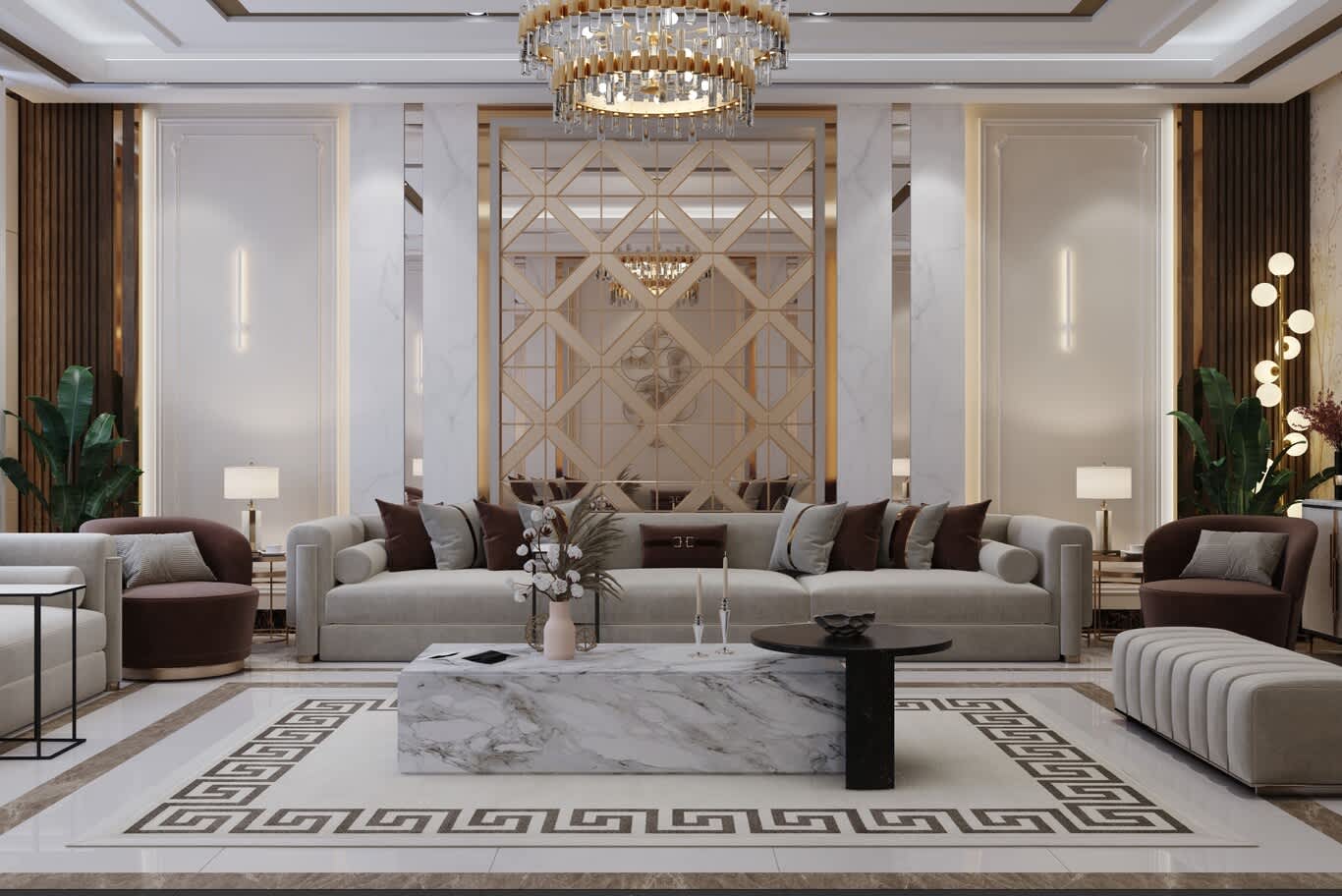
Nowhere is the divergence sharper than in the room that anchors Gulf hospitality. In Abu Dhabi the dual-majlis arrangement remains close to standard in family villas: separate men's and women's majlis, each with its own entrance from the street or forecourt, its own guest washrooms, and full acoustic and visual separation from the family quarters, so hospitality proceeds at scale without the household ever being on display. The rooms themselves run formal and generous — carved gypsum, coffered ceilings, chandeliers sized to the volume, seating for twenty and upward, a coffee station and incense ritual designed into the architecture rather than wheeled in on a trolley. Dubai villas honour the majlis with a freer hand, and many briefs ask for a single integrated majlis-lounge that flexes between formal reception and family evenings, contemporary in finish, with tradition carried in the seating arrangement and the serving ritual rather than in architectural separation.
One room, two briefs, and the questions that decide it
Because the majlis carries this much cultural weight, our consultants open the subject the same way in both cities — how do you receive, how often, at what scale, and with what degree of formality — and let the answers set the architecture. An Abu Dhabi family hosting forty men on a Thursday evening needs the separated wing, the dedicated washrooms, the service corridor that lets coffee arrive without crossing the family hall; a Dubai household receiving twelve mixed guests for dinner needs flexibility, sightlines, and a room that converts from reception to film night by ten. The full spectrum of both readings, from carved classical chambers to lounge-like contemporary interpretations, runs through our majlis interior design in Dubai practice, and the first sketch our designers produce in either city is always the guest's journey from the gate to the seat of honour.
Plans drawn for a family tree versus a lifestyle
Abu Dhabi's residential fabric — Al Shamkha, Khalifa City, Mohammed Bin Zayed City, the family districts of the mainland — is drawn on plots sized for extended households, and the interiors follow: ground floors organised around reception and hospitality, upper floors holding suites for married sons or visiting grandparents alongside the family bedrooms, service wings with proper staff quarters and a working second kitchen where the daily cooking happens away from the show kitchen. Circulation is engineered for privacy, with guest routes and family routes that need never cross. Dubai plans, particularly across the gated villa communities, are drawn for the nuclear household and its entertaining: open living-dining volumes flowing to the terrace and pool, a show kitchen at the social centre, a home office and gym claiming the rooms Abu Dhabi assigns to relatives, and sightlines composed toward whatever the community offers — golf, water, skyline.
Style compasses pointing in different directions
Ask each city for "luxury" and the mood boards part ways. Dubai's centre of gravity sits in the contemporary register — clean volumes, warm minimal palettes, statement stone, European furniture silhouettes — with clients tracking global movements closely and asking for them by name. Abu Dhabi's centre of gravity holds nearer the classical and the Arabic: full classic and neo-classic schemes with boiserie and gilding, and a deep, confident current of modern Islamic design in which mashrabiya screens, geometric pattern, calligraphy, and pointed-arch geometry are rendered in contemporary materials. The distinction is a leaning rather than a law — Saadiyat and Al Jubail villas take beautifully to contemporary schemes, and Emirates Hills holds some of the region's grandest classical interiors — but a designer who arrives in the wrong city with the wrong default has misread the room before drawing it.
Ornament, pattern, and the courage each city keeps
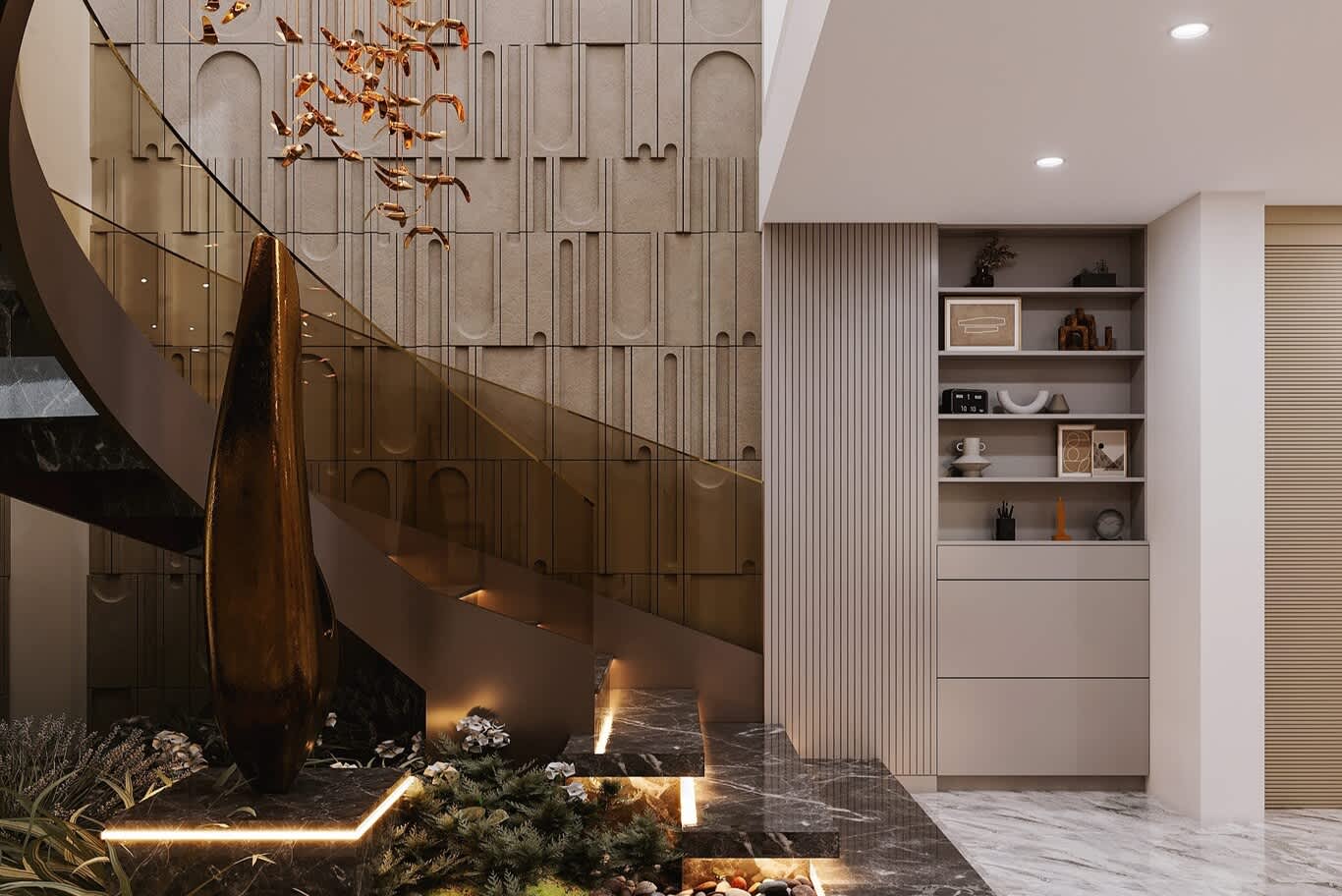
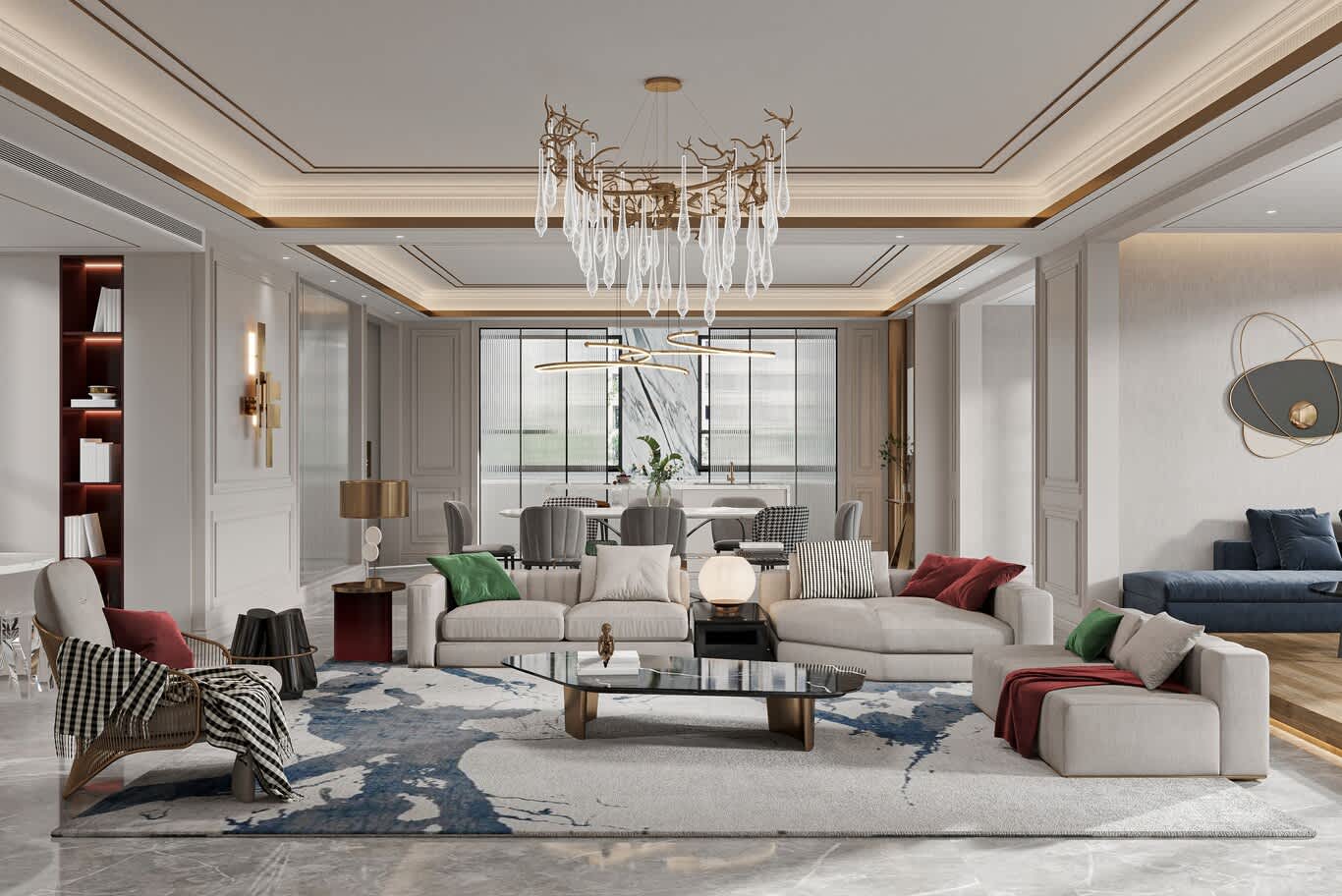
The decorative temperature differs even when the style label matches. An Abu Dhabi contemporary villa will typically carry more ornament than its Dubai twin — a carved screen at the double-height void, patterned marble inlay at the entrance, ceilings that receive genuine design attention rather than flat gypsum — because the decorative traditions of the majlis culture extend naturally through the house. Dubai's contemporary schemes hold their drama in material and scale instead: a single book-matched slab wall, oversized pendants, sculptural staircases, and generous emptiness deployed as confidently as any pattern. The two approaches are two grammars of richness rather than a ranking, and our decor teams keep both fluent — layered pattern and gilt for one city's taste, edited monumentality for the other's — switching registers between site visits the way a good tailor switches between cloth weights.
What the price tag proves in each city
Both markets spend seriously, and both markets have learned — sometimes expensively — that spending and succeeding are different achievements. A Dubai villa can carry half a million dirhams of Italian furniture and still feel like a showroom if proportion and editing were never engaged, while an Abu Dhabi majlis can gleam with gilt yet fail its own hospitality if the seating protocol was drawn wrong; in either city the shortfall traces to the same confusion between cost and quality. The distinction deserves its own essay, and we gave it one in our examination of why some rooms feel genuinely luxurious while others merely feel costly. Craft, proportion, and specificity to the household decide the outcome in both emirates; the invoice never does.
Colour and material palettes, city by city
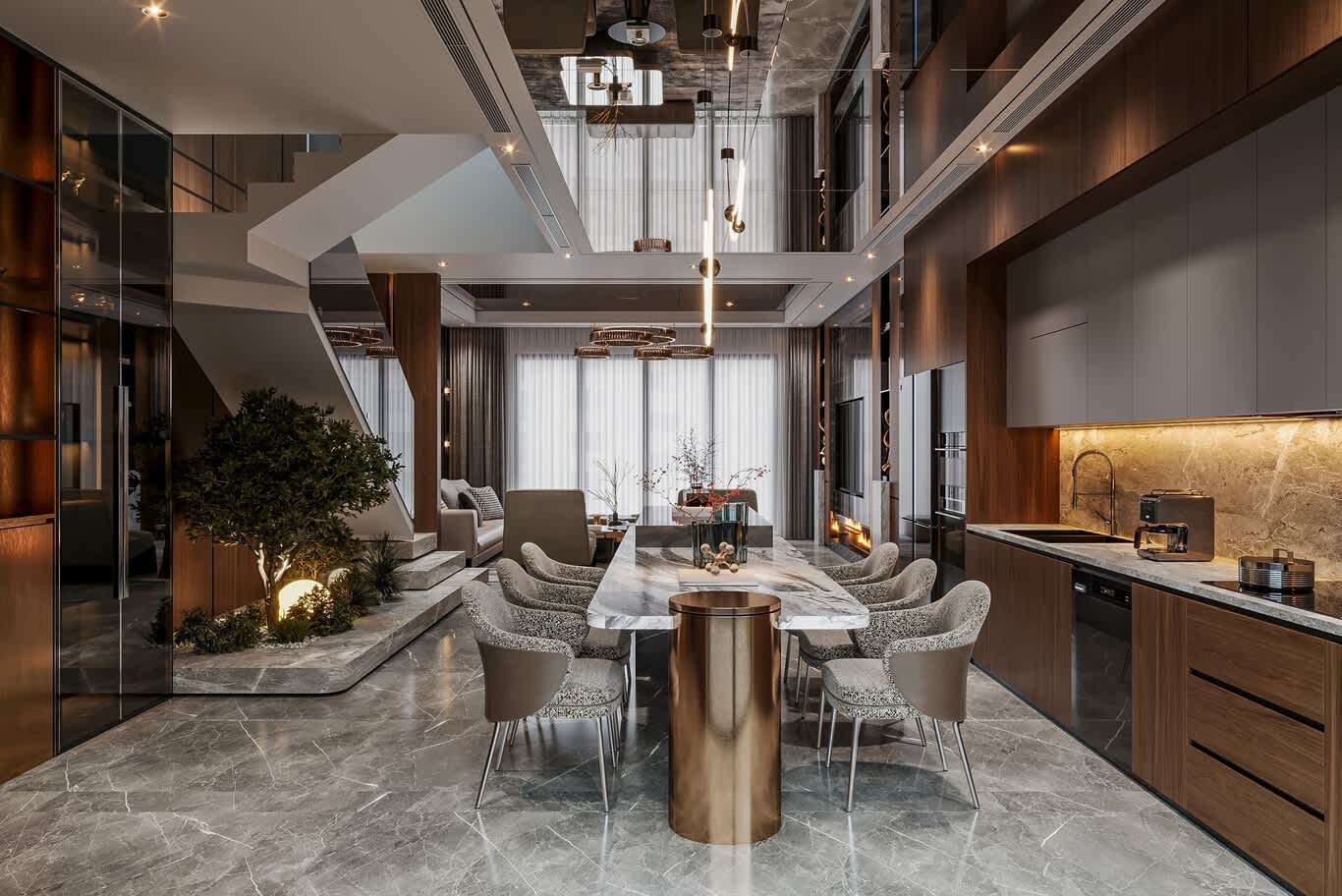
The palettes follow the style compasses. Dubai villas currently favour the warm neutral field — bone, sand, greige — with drama in stone movement and bronze detail, and adventurous clients borrowing saturated European registers for a study or dining room. Abu Dhabi palettes run warmer and deeper as a baseline: creams and golds in the classical schemes, earth tones and rich woods in the modern Islamic ones, burgundies and forest greens upholstering the majlis in velvet. Material loyalties differ too — Dubai reaches for travertine, fluted oak, and honed finishes; Abu Dhabi keeps a stronger relationship with polished Calacatta and Statuario, walnut and mahogany tones, brass and gold metals, and carpet-grade rugs sized to formal rooms. Climate is the shared constant, with both cities demanding stone floors, lined curtains against the glare, and finishes that shrug off fierce summers.
Privacy engineering versus view engineering
The two cities solve the window differently. Dubai villa design is substantially view-driven — glazing maximised toward the fairway, the water, or the skyline, sheers rather than heavy drapery, outdoor living staged as an extension of the interior for the photographable eight months. Abu Dhabi design gives privacy the senior vote: fenestration composed so neighbouring villas and the street read nothing of the interior, courtyards and internal gardens delivering light without exposure, screens filtering the western sun and the passing gaze at once. The difference reaches the decor layer — mirror placement, the direction furniture faces, where the television wall may and may not go — and it is one of the quietest but most reliable tells of which city a floor plan was drawn for.
Kitchens: the stage and the engine room
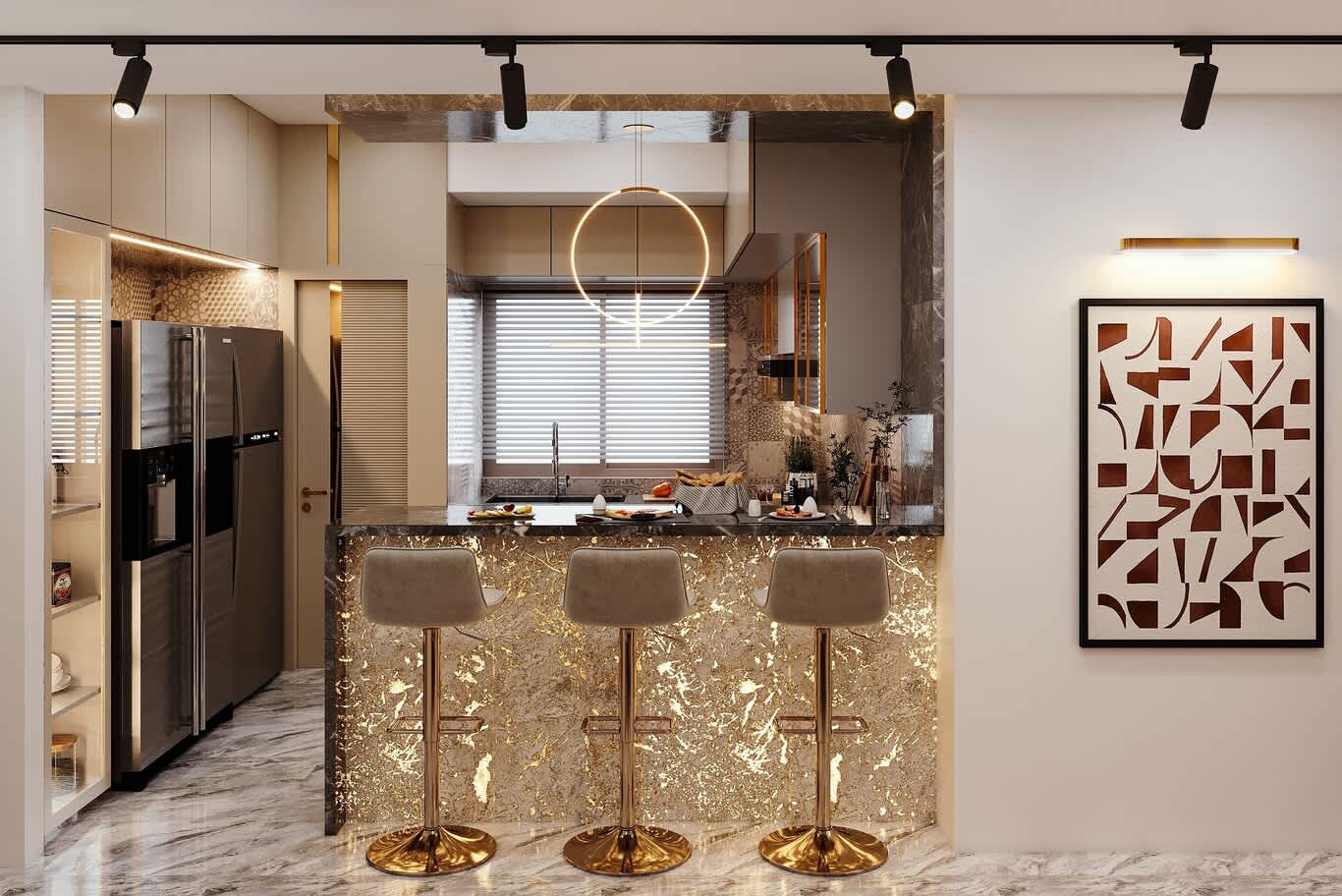
The kitchen question receives two different answers on either side of the border. Dubai briefs increasingly place the kitchen at the social centre of the villa — an island in book-matched stone facing the living volume, appliances displayed like instruments, wine storage behind glass, the room designed to be watched while it works. Abu Dhabi briefs almost always split the function: a show kitchen presenting beautifully toward the family and dining spaces, and a fully equipped working kitchen behind it where the daily cooking for a large household proceeds at scale, vented, durable, and staffed. The split doubles the joinery package and the MEP coordination, and it is one of the first line items our fit-out estimators adjust when a project crosses from one emirate to the other.
Two approval regimes on either side of the border
The paperwork diverges at the city limits, and the divergence is practical rather than trivial. Dubai villa works proceed under Dubai Municipality or Trakhees depending on the address, plus the master developer's NOC, each community with its own conditions on working hours, contractor registration, and site conduct; submission formats and inspection milestones are a fluency of their own, and our engineers file them daily as part of our villa fit-out services in Dubai. A team that treats the approvals as an afterthought donates weeks to the calendar before the first trade mobilises.
The Abu Dhabi regulatory picture
Cross into the capital and the file changes jurisdiction: works run through the Department of Municipalities and Transport and Abu Dhabi Civil Defence, with their own drawing standards, MEP compliance details, inspection sequences, and completion certification. The requirements are exacting in different places than Dubai's — fire and life-safety review carries particular weight, and the documentation culture rewards engineering thoroughness over speed. Our delivery teams in the capital maintain this fluency as standard, and the finished record of it stands in our fit-out projects in Abu Dhabi portfolio, delivered from first submission to final certificate without the file ever leaving our own engineers' hands.
Renovation rhythms and new-build appetites
The two markets also generate different project types. Dubai's established villa communities produce a deep renovation and upgrade economy — homes changing hands and receiving full interior transformations within their existing shells, kitchens and bathrooms modernised, layouts opened, the work choreographed around demolition surprises and community working-hours rules. Abu Dhabi produces a higher share of ground-up family builds on secured plots, where the interior team is engaged while the structure rises and the fit-out follows construction as one continuous programme keyed to structural handover dates. The two paths run on different calendars and different risk registers, and each rewards a studio that has walked it many times before.
What the calendar honestly holds
However the project type falls, the family's first practical question is the same in both cities — how long until we move in — and it deserves an answer built from phases rather than optimism. Design, approvals, procurement, site works, and handover each carry their own clock, the clocks overlap where good sequencing allows, and the ranges differ meaningfully between a Dubai renovation and an Abu Dhabi new build. We published the honest arithmetic in our phase-by-phase account of how long a villa project really takes, and the ranges quoted there are the ones our project managers stand behind in either emirate. A programme presented in phases can be protected; a single hopeful number can only be missed.
The invisible work between approval and keys
Between the signed concept and the final walkthrough sits the stretch of the project clients see least — technical documentation, tender, procurement across three continents, construction administration, and the relentless inspection culture that manufactures a serene handover — and the work is identical in discipline whichever emirate hosts the site, even as the approvals and logistics differ around it. The full anatomy of that middle ground, from joinery drawings resolved to the hinge through to the defects liability period that follows the keys, is laid out in our tour of everything a studio does between concept and handover. Families who read it once tend to interrogate their tenders far more sharply afterward.
Hospitality calendars shape the decor layer
The decorating brief carries each city's social calendar inside it. Abu Dhabi households host at family scale and religious rhythm — Ramadan majlis evenings for forty, Eid receptions, weekly extended-family lunches — so the decor layer is specified for durability at volume: seating counts held high, fabrics chosen to survive a decade of gatherings, dinner services and serveware storage planned like a hotel back-of-house. Dubai hosting skews toward the dinner party, the terrace evening, and the seasonal open house, and its decor layer responds with bar counters, show kitchens dressed to be watched, and outdoor lounges furnished to interior standard. Both cities take hospitality seriously; they simply throw different parties, and the cushions know it.
Where the two cities are converging
The gap, honestly reported, is narrowing at the edges. Young Emirati families in Abu Dhabi increasingly commission contemporary and warm-minimal schemes with the dual majlis intact inside a modern envelope, while Dubai's Emirati districts keep full classical traditions in confident health; Saadiyat's cultural gravity is pulling collector-grade contemporary interiors north, and Dubai's maturing communities are producing renovation briefs of Abu Dhabi-like permanence as families decide to stay for good. The modern Gulf villa often wants elements of each city's grammar — a classical majlis beside a minimal family wing, pattern in dialogue with restraint — and fluency in both has become the real qualification for designing in either.
Writing the brief that bridges both cities
A villa that borrows from both philosophies succeeds only when the borrowing is deliberate, and the instrument of that deliberateness is the brief — the household mapped by name and generation, the hospitality protocols recorded, the budget structured, the immovable dates separated from the hopeful ones, and the decision-makers agreed before the first presentation. The document matters even more on a two-grammar project, since a classical majlis and a minimal family wing must be reconciled on paper before they can be reconciled in gypsum and stone. Our guide to assembling the brief that keeps a project serene from first meeting to move-in walks through every element, and an hour spent with it repays itself across the entire programme.
Choosing your studio in the capital
Abu Dhabi families face a further question Dubai rarely poses as sharply: which studio genuinely understands the capital's conventions rather than commuting its Dubai defaults down the E11. The tells are specific — fluency in dual-majlis planning, DMT and Civil Defence documentation produced in-house, classical and modern Islamic portfolios of real depth, and references from Emirati households rather than only expatriate ones. We set out the full checklist in our advice on finding the right design consultant in Abu Dhabi, and it applies whichever studio a family ultimately engages. The capital rewards the practices that learned it properly.
The service behind both grammars
The range this article has described — dual-majlis chambers and view-first lounges, boiserie and book-matched slabs, DMT files and Emaar NOCs — sits within a single discipline practised at full width, and holding both grammars under one roof is what lets a family commission a classical reception wing and a contemporary private wing without hiring two studios to argue with each other. The complete residential practice, from palaces to family villas across both emirates and the wider region, is gathered under our luxury villa interior design services, where the portfolios of both cities sit side by side and the differences this article describes can be read directly off the drawings.
Design your villa with ALGEDRA, in either city
Our designers, decorators, and fit-out teams hold live projects in both capitals, with the service calibrated to each: dual-majlis planning, classical and modern Islamic schemes, and DMT-ready documentation through our interior design company in Abu Dhabi studio, and contemporary, view-led transformations across Dubai's communities from the Palm to Emirates Hills.
Ready to begin in either emirate? Contact us today — send your project details through our contact form and one of our design consultants will get back to you at the earliest.
FREE CONSULTATION
TELL US ABOUT YOUR PROJECT
WE WOULD LOVE TO HEAR FROM YOU
Feel free to reach us via this contact form and one of our Design Consultants will get back to you at earliest.
OUR BRANCHES
UAE - DUBAI
+971 52 8111106 | hello@algedra.ae
TURKEY - ISTANBUL
+90 533 701 89 71 | info@algedra.com.tr
Leading Interior Design and Decor Company in Dubai and Abu Dhabi.
Algedra is a reputable, internationally recognized, and one of the most successful interior design companies in Dubai, and Abu Dhabi, which specializes in delivering interior design, architectural, and creative space planning projects throughout GCC, MENA, North Africa, Turkey and Russia.
Algedra is a one-stop solution for all your residential interior design and fit-out needs. We have successfully completed numerous villa interior and exterior design projects, where we integrated quality and originality to deliver interior masterpieces.
ALGEDRA, Interior Design Company in Dubai, is specialized in providing elegant and stunning interior design services for both residential and commercial projects. We turn our clients' dreams into reality, trans- lating their tastes and needs into beautiful and functional spaces.
Since the day we were founded, we have designed and built many branded residences, resorts, hotels, multi-purpose social spaces, and palace designs with different functions and concepts by following the ever-changing design trends over the world.
A key element of our work is a fusion of different cultures and designs, combining Greek, Italian, Eastern and Western influences with British innovation.
As a team of highly qualified interior designers and engineers, Algedra offers complete architectural services from mall design to corporate office design as well as the exterior design of any project based on customers' needs.
Our customers include leading names, we have completed diverse projects in hospitality, landscape, commercial, and residential designs. These projects contain cafes, restaurants, gym, villas, family sitting rooms, bedrooms, kitchens; all showcasing our company's exquisite details and high-end designs.
Residential Interior Design in Dubai
Algedra's interior designers and architects have an important mission: building villas, houses, apartments, condos, and anywhere else where you reside that will fulfill your needs while being structurally safe and sound.
Architectural Designs
There are so many details that go into designing an architectural design project. Every step of the project has been carefully considered for safety and daily comfort by Algedra's experts.
Commercial Design
Conceptualizing spaces for business, to elevate style, and to increase functionality to help enhance the bottom line of a company is vital, as well as employee comfort and interior design too. Our commercial interior designers translate client's concept in ways that are efficient, attractive and provide professional workspaces.
Fit-out Projects
Algedra Interiors delivering high-quality tailored fit-out projects that transform your villas, palaces and commercial spaces.
We're a passionate team of interior designers, architects and engineers. Every day we help clients to solve interior design problems and create engaging spaces!
Wherever you are in Kuwait, Saudi Arabia, Azerbaijan, Qatar, Morocco, Algeria, Tunisia, Libya, Egypt; don't hesitate, contact us to find out more about why we are one of the best interior design companies in Dubai and Abu Dhabi!