Home Page | Blog | Top Ideas For Garden Pathway Tiles
Top Ideas For Garden Pathway Tiles
9/13/2015
Over two hundred residential and palace landscape projects across the UAE, Saudi Arabia, Kuwait, and Qatar have informed ALGEDRA’s approach to garden pathway tile specification. Travertine arrival courts at 1,800 mm wide, 80 x 80 cm porcelain pool terraces at R11 anti-slip, hand-laid mosaic medallions at garden path junctions, sensor-driven drip irrigation beneath rock garden aggregate: each material and technique in this guide comes from a built and monitored project record.
UAE conditions introduce variables that temperate-climate design guides underweight. Surface temperatures on dark stone reach 70°C at noon in July. Thermal cycling in concrete substrates cracks continuous slab paving over three to five seasons. UV exposure bleaches lower-grade ceramic glazes within two years of installation. Irrigation runoff from adjacent planting creates permanent wet-zone conditions on paths that owners assumed would stay dry. Every specification decision in this guide accounts for those variables with figures drawn from completed and maintained regional projects.
Historically, pathway tile is among the oldest hardscape traditions on record. Ancient Egyptian builders cut limestone for ceremonial courtyards at Karnak. Moorish craftsmen carried hand-painted ceramic traditions from North Africa through Andalusia to the Americas. Mediterranean builders developed terracotta tile partly because local timber was scarce for flooring. Those lineages feed directly into the material categories below and understanding them matters when specifying for a property whose architecture belongs to one of those cultural traditions.
1. Natural Stone
Travertine from the Denizli basin in southwest Turkey is the most specified stone for luxury villa arrival paths across Dubai and Abu Dhabi. Its naturally vesicular surface delivers R11 slip resistance with zero mechanical processing required. Thermal conductivity sits at approximately 0.9 W/m·K, keeping it considerably cooler underfoot at midday than granite at 2.7 W/m·K or dark basalt at 1.7 W/m·K. Cream and ivory tones carry a Solar Reflectance Index of 65 to 80, which is practically significant when guests arrive in formal attire through the June-to-September heat peak. Consistent supply from Turkish and Iranian quarries holds per-square-metre cost in the AED 140 to 280 range for honed 600 x 400 mm format, making it competitive against large-format porcelain at equivalent quality grades.
Limestone suits formal gardens where the path surface is designed to recede behind the planting rather than register as a visual feature in its own right. Its finer, more uniform texture gives joints and edges a precise, architectural quality. Indian Kandla Grey and Raj Green sandstone are the most consistently available golden and buff varieties in UAE supply chains; both suit relaxed, naturalistic garden schemes and pair well with timber pergola structures, gravel areas, and planted borders in soft terracotta and sage tones. Granite handles the highest foot traffic loading and light vehicle access; a flamed or bush-hammered finish brings the material to R10 minimum for exterior pedestrian use and reveals the characteristic crystalline structure that makes granite visually distinctive.
Fixing stone tone, grout colour, and planted edge treatment simultaneously in the concept drawing is how ALGEDRA’s this villa garden project achieved visual coherence across multiple garden zones. Treating those as sequential rather than concurrent decisions typically produces a mismatch between the stone and its surroundings that subsequent adjustments rarely resolve fully. The technique also applies on ALGEDRA’s exclusive Dubai villa project, where 600 x 400 mm honed Denizli travertine on a 38-metre arrival path was specified alongside pleached olive trees on 1,200 mm centres in the same concept session.
1.1 Stone pathway specification summary
• Honed, brushed, or flamed finish on all exposed paths. Minimum R10 for pedestrian routes; R11 for wet zones and pool surrounds.
• Full mortar bed over compacted MOT Type 1 sub-base at minimum 150 mm depth for pedestrian-only paths on UAE soil conditions.
• 1.5 to 2 percent crossfall across the full path width to move surface water clear.
• Annual penetrating impregnator application to repel oil and water while preserving the stone’s surface texture.
• Grout colour matched within one tone of the stone, keeping joint lines visually recessive.
2. Ceramic and Porcelain
Large-format rectified porcelain dominates contemporary UAE residential garden path and terrace specifications for well-documented technical reasons. Water absorption below 0.5 percent, classified as Group BIa under EN 14411, delivers consistent performance through daily irrigation cycles. UV stability tested to 2,000 hours of xenon arc exposure per EN ISO 105-B02 preserves surface colour across the full lifespan of a luxury villa landscaping contract. Rectified cutting to tolerances of plus or minus 0.3 mm allows joints as tight as 2 mm, producing a surface finish that gives large arrival courts and pool terraces a resolved, continuous quality.
Format scale has a direct and measurable effect on spatial perception. On a 1,800 mm wide path, a 30 x 30 cm tile produces 36 joints per linear metre of path length. An 80 x 80 cm format reduces that to five joints per linear metre, and the reduction in visual noise allows the architecture and planting to register clearly. For sheltered terraces and pool surrounds, 60 x 120 cm plank-format porcelain creates a directional reading that draws the eye along the long axis of the garden. Warm-toned mid-greys and sand-coloured porcelains sit most comfortably within the regional landscape palette and maintain low visible soiling between cleaning cycles in sandy conditions.
Hand-made ceramic tiles offer colour saturation and surface warmth that porcelain manufacturing offers at a different quality register. Their appropriate positions in a garden scheme are focal and limited: step risers on formal staircases, inset feature panels within a porcelain field, courtyard centre medallions in Arabic or Mediterranean-style gardens.
On ALGEDRA’s this palace landscape commission, hand-painted Moroccan ceramic covered the risers of a 14-step formal staircase connecting two garden terraces. That 3.5 square metre surface carried the entire decorative responsibility for that zone of the garden and justified the premium over porcelain on those specific elements alone.
For a project-scale demonstration of how porcelain format, tone, and path width interact, ALGEDRA’s Abu Dhabi luxury landscape project specified 800 x 800 mm porcelain in warm light grey at Solar Reflectance Index 58 across a 35-metre path at 2,000 mm width. That combination kept planted borders on either side as the dominant visual element rather than the paving surface itself.
2.1 Ceramic and porcelain specification notes
• R11 anti-slip rating for pool decks and any path within 2 metres of irrigation heads or drainage channels.
• Rectified porcelain for primary paths and terraces; hand-made ceramic reserved for focal feature positions with low foot traffic.
• Format minimum 600 x 600 mm for paths wider than 1,200 mm; scale tile dimension to path width at a ratio of 1:2 to 1:3.
• Anti-fracture membrane between mortar bed and tile layer on any substrate subject to thermal movement, which is standard practice across UAE projects.
3. Carpet Tile Arrangements
Carpet tile arrangements bring the compositional logic of a floor rug into the outdoor ground plane. A defined field of patterned tiles is laid within a border of contrasting material, giving the composition a frame that anchors it within the wider garden. The border tile carries as much design responsibility as the field: it is what converts a patterned paving area into a legible design element with defined edges and visual weight proportional to the space it occupies.
Hexagonal, chevron, and arabesque formats generate geometric energy and directional rhythm that rectangular tiles in a standard running bond reserve entirely for the border detail. In contemporary garden schemes this contrast between a precise geometric ground plane and organic planted borders is one of the most effective spatial tools available. It creates a strong outdoor-room reading through the floor plane alone, with the tile composition providing the spatial definition that vertical enclosure provides indoors.
On ALGEDRA’s luxury estate and mansion landscape designs, carpet tile arrangements have defined outdoor rooms within large garden plans: a 3,600 x 3,600 mm hexagonal tile circle marking the seating node in a gravel garden and a 4,200 x 2,400 mm chevron field anchoring the dining terrace off a main kitchen wing. Both carpet dimensions were calculated relative to the furniture footprint and the structural grid of the adjacent building, and fixed in the concept drawing before any tile format was selected. That sequencing matters: tile format chosen after the carpet dimensions produces a more resolved, intentional result than dimensions adjusted to suit a pre-selected tile.
3.1 Carpet tile layout principles
• Set out from the visual centre of the carpet area, aligned to the primary structural axis of the adjacent building.
• Maintain consistent grout joints throughout: 3 to 5 mm for rectified porcelain, 8 to 10 mm for natural stone.
• Specify the border tile in a contrasting tone drawn from the same material family as the field tile to maintain material coherence.
• Allow a minimum 50 mm gap width for planted joints so ground cover establishes root depth and sustains growth through summer heat.
4. Interlock Brick
Interlocking concrete pavers tolerate thermal cycling and ground movement by design. Each unit shifts independently within the bedding sand layer rather than transmitting stress across a bonded surface, so the path absorbs the thermal expansion and contraction that UAE summer-to-winter temperature swings impose on sub-base soils. Over a ten-year service period, this characteristic produces demonstrably fewer maintenance interventions than continuous mortar-bedded slabs on the same substrate conditions.
Colour, texture, and laying pattern choices give interlock brick a broader design range than its utilitarian reputation suggests. A dark charcoal paver in running bond on a formal path with clipped hedging reads as clean and contemporary. Buff or terracotta-toned pavers in herringbone on a family garden loop read as relaxed and domestic. Textured split-face pavers in warm buff tones work well on informal rock garden paths and in planting-adjacent zones where the slightly rougher surface suits the informality of the surrounding material palette. Available surface profiles also include smooth pressed and tumbled finishes, each producing a distinct visual texture at close range.
On ALGEDRA’s commercial landscape designs, interlock serves wide service access routes and secondary garden circulation, concentrating the premium stone and porcelain budget on primary guest-facing surfaces. Per-square-metre cost savings against natural stone at equivalent installation quality typically range from AED 80 to 150, and ten-year maintenance requirements are lower because individual pavers can be lifted and replaced when sub-surface services require access, at zero damage to the surrounding surface.
4.1 Interlock specification notes
• Minimum 60 mm unit thickness for pedestrian paths; 80 mm where vehicle access is possible.
• Sharp sand bedding layer over compacted Type 1 sub-base allows individual units to be lifted and relaid for service access at any point in the path’s life.
• Kiln-dried jointing sand compacted by plate vibrator immediately after laying, with a second application after initial settlement.
• Penetrating sealer reapplied every three to five years to resist oil staining and UV colour fade in UAE conditions.
5. Mosaic
Mosaic is specified for its authored quality as much as its technical performance. Hand-laid glass, stone, or ceramic tesserae, typically in 20 x 20 mm or 25 x 25 mm units set in white polymer-modified mortar, produce surface patterns whose complexity and precision signal craft investment in a way that manufactured tile production achieves only at the very highest custom specification levels. The traditions informing contemporary garden mosaic are deep: Byzantine ecclesiastical floors in Constantinople, Roman domestic mosaics at Pompeii and Herculaneum, the geometric Nasrid work at the Alhambra, and the Safavid court architecture of Isfahan all used mosaic because the surface was designed to reward extended close attention rather than a single glance.
In UAE garden conditions, glass tesserae hold their colour and reflectivity across decades when set in a properly prepared substrate and protected from heavy foot traffic. Stone tesserae in marble, travertine, or granite carry their natural colour variation into the pattern and produce a warmth that glass-only mosaics, however technically precise, achieve. Mixed-media compositions combining glass, cut stone, and occasional mirror elements are the most visually complex option and are best reserved for sheltered courtyard positions where rainfall and high foot traffic are controlled.
On this Abu Dhabi villa commission, ALGEDRA set a 1,200 mm diameter medallion in hand-cut marble and glass tesserae at the central junction of four garden paths. Its geometric pattern derived from the arabesque screen metalwork inside the villa, creating a material thread between the interior and the outdoor ground plane that both residents and visitors identify as the most memorable detail of that garden. The medallion is visible from the first-floor terrace at 8 metres above the garden level, and its diameter was calculated to read as a compositional anchor from that elevation as well as at close range on the path surface itself.
5.1 Where mosaic earns its specification
• Circular or radial path junctions with a clear sightline from a terrace, balcony, or first-floor window above.
• Step riser sequences on formal staircases of four or more risers, where the vertical face accepts decoration at eye level on the descent.
• Fountain base surrounds and pool edge bands seen from above and at water level simultaneously.
• Sheltered courtyard floors protected from direct rainfall and concentrated foot traffic.
6. Stepping Stones
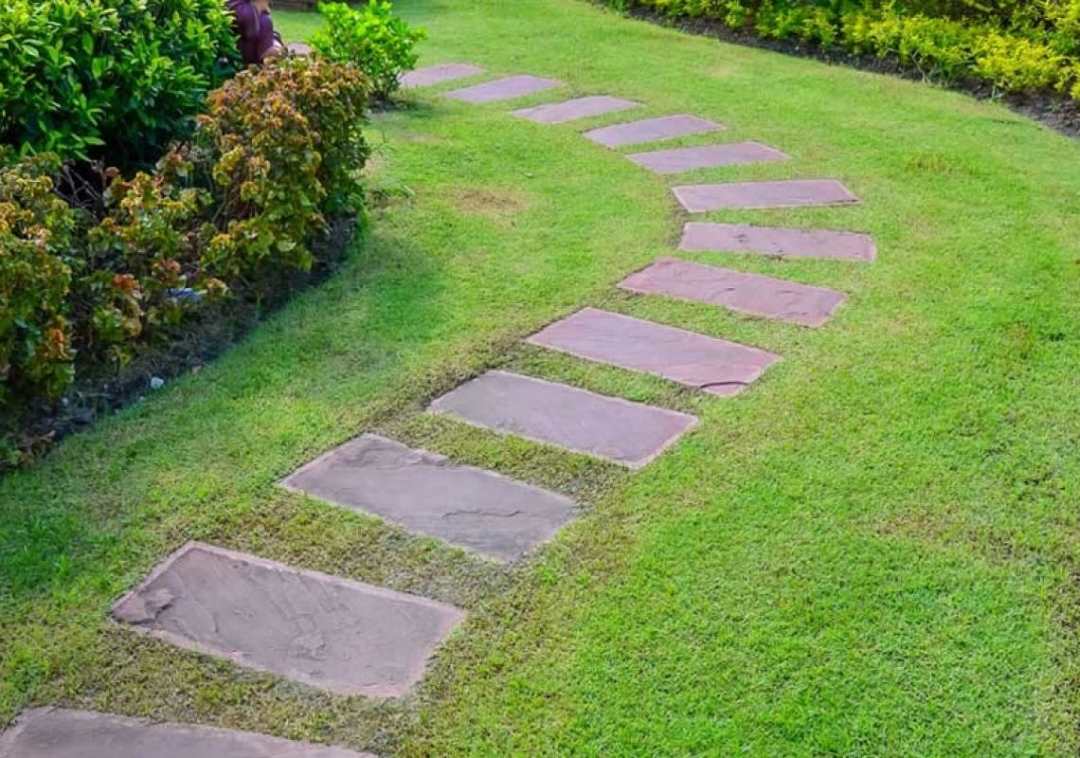
Stepping stone sequences change walking pace and heighten a visitor’s awareness of the garden on either side of the path. Each stone requires a small confirmation of footing before weight commits, and that slight attentional demand produces a more deliberate, observant movement through the planting than a continuous surface permits. That quality makes stepping stones valuable in garden zones designed for observation and quiet occupation rather than direct functional circulation between two destinations.
Natural flat stone, placed at organic intervals into lawn or low ground cover, suits naturalistic planted gardens where irregular placement reinforces the character of the surrounding landscape. Large pieces of Caithness slate, aged sandstone, or bush-hammered granite are the most commonly specified materials in UAE luxury garden projects because their irregular outlines and varied surface textures produce a discovered quality that pre-formed units rarely match. Pre-formed step stones in consistent geometric shapes, round or square, suit more structured formal settings where irregular placement would conflict with the architectural order of the surrounding design.
Spacing and setting depth determine whether a stepping stone path functions comfortably or frustrates the people using it. Centre-to-centre spacing of 600 to 650 mm suits an adult walking stride at a relaxed pace; 550 to 600 mm is more appropriate for paths shared with elderly users. Stones set with their face 5 to 10 mm above the surrounding turf or ground cover remain consistently visible through the growing season and allow mowing machinery to pass over them at the lowest cutting height. Stones set flush with turf level become obscured by grass growth within one growing season, requiring regular manual trimming to keep the path legible.
Species selection, planting spacing relative to stone position, and irrigation management at stone edges in UAE conditions are covered in ALGEDRA’s landscape design ideas blog, including ground cover varieties that establish quickly, tolerate compaction at stone edges under regular foot traffic, and remain green through summer heat with minimal irrigation input.
7. Rock Garden Pathways
Rock garden paths merge hardscape surface and planting into a single material composition rather than treating them as separate layers. Loose aggregate, typically crushed gravel, pea shingle, or decomposed granite at 10 to 20 mm grading, forms the path surface. Larger specimen stones are placed deliberately within the aggregate to provide structural punctuation and visual scale. Drought-tolerant planting occupies the gaps and edges: lavender, rosemary, ornamental grasses, Agave attenuata, Sedum varieties, and dwarf Bougainvillea all perform reliably in UAE conditions with drip irrigation once root systems are established after the first growing season.
Aggregate surfaces drain immediately after irrigation or rainfall events, eliminating the ponding and surface staining that accumulate on grouted tile paths in planting-adjacent zones. Maintenance requirements are substantially lower than grouted hard surfaces: aggregate can be raked level and replenished as needed, specimen stones require only periodic repositioning if ground movement disturbs them, and drought-tolerant planting borders require minimal pruning and feeding compared to lawn or formal hedging. Material palette in warm grey and buff stone tones with silver-green foliage connects visually with the regional landscape in a way that manufactured tile surfaces achieve only when specified with deliberate regional reference.
ALGEDRA’s smart and automated landscape design service integrates soil moisture sensor-driven drip irrigation beneath rock garden path planting. Water is delivered to root zones at night, eliminating daytime evaporation from exposed aggregate and reducing total irrigation volume by 40 to 60 percent compared to conventional overhead spray systems covering the same planted area. That saving is consistent across monitored UAE projects and translates to a meaningful reduction in annual utility cost on large-area rock garden installations. The broader ecological dimensions of aggregate pathway design, covering how permeable surfaces interact with stormwater drainage, urban heat load reduction, and pollinator habitat, are covered in ALGEDRA’s ecological impact of landscape design article.
8. Terraced and Multi-Level Pathways
Gardens with level changes between 600 mm and 3,000 mm across their plan give the landscape architect the means to create a sequence of spatially distinct zones, each at a different elevation, each offering a different view and planted character. What reads on a flat site as a single garden becomes on a sloped site a sequence of revealed spaces, each discovered by descending or ascending through it. That spatial potential is one of the strongest arguments for treating a topographic challenge as a design opportunity rather than a grading problem to be flattened.
On a sloped site, pathway and retaining structure are inseparable as design elements. Step tread material, riser cladding, retaining wall facing, and edge planting require resolution as a unified composition at the concept stage. ALGEDRA’s villas and palaces landscape design service includes terraced pathway design as a core offering for elevated plots across Dubai and Abu Dhabi, where level changes between street and garden are common in established villa districts. Contractor procurement and structural engineering begin only after the visual composition of each level is fixed and agreed, which prevents the coordination problems that arise when engineering and landscape design develop on separate tracks.
UAE Building Code and Dubai Municipality regulations set a maximum riser height of 175 mm and minimum tread depth of 280 mm for external staircases. ALGEDRA’s standard for garden staircases is 150 mm risers and 350 mm treads, a proportion that accommodates guests in formal attire and produces a comfortable descent pace at any walking speed. Handrails are required for any flight of more than four risers at minimum 900 mm height and loading specification to BS EN 1991-1-1 category C3. Low-voltage LED riser lighting at 2.5 to 3 watts per step and 2700K colour temperature is included on every staircase ALGEDRA delivers, positioned at the base of each riser for maximum tread illumination and minimum upward glare on the ascent.
Drainage at the base of each retaining wall is the most consequential engineering detail in terraced garden design. A 100 mm perforated land drain set in a 300 mm granular filter bed at the wall base, connected to the site drainage network, is ALGEDRA’s standard specification. This configuration manages the hydrostatic pressure that builds behind retained earth and irrigation-saturated soil, which is the primary cause of retaining wall movement across UAE residential landscape projects. Material strategies for sloped sites, including how planted retaining walls and cascading water features integrate structurally with path and staircase design, are covered in ALGEDRA’s top ideas for designing your landscape guide.
8.1 Terraced pathway specification checklist
• Riser height 100 to 175 mm; tread depth minimum 300 mm. ALGEDRA standard: 150 mm riser, 350 mm tread.
• Step tread material drawn from the same material family as the adjacent path surface to maintain visual continuity across each level transition.
• Low-voltage LED riser lights on every flight of more than three steps: 2.5 to 3 W per step, 2700K colour temperature.
• 100 mm perforated land drain in 300 mm granular filter bed at base of each retaining wall, connected to site drainage network.
• Handrails for flights of more than four risers: minimum 900 mm height, BS EN 1991-1-1 category C3 loading specification.
9. ALGEDRA’s Material Selection Process
Every pathway specification at ALGEDRA begins with a site analysis document recording orientation, solar exposure by garden zone, soil bearing capacity, drainage behaviour during irrigation cycles, proximity to salt air where coastal, and the material language of the building facade. Our landscape design services page documents the full analysis-to-specification workflow across all project types. Four variables most frequently determine the final material choice.
9.1 Path function and traffic intensity
Principal arrival paths serving villa entrances must perform across the full range of footwear including heels, sustain their appearance under event photography conditions at any time of year, and read with equal clarity across their full length at any time of day or season. Service paths connecting kitchen to utility areas carry a different brief entirely. Allocating budget proportionally to functional and visual importance, premium stone on the arrival route and interlock brick on secondary paths, consistently produces better outcomes than applying a single material across the full path network. ALGEDRA’s residential landscape portfolio documents this budget allocation approach across projects at multiple scales.
9.2 Thermal performance by zone
Surface temperature on south-facing unshaded Dubai paths peaks between 12:00 and 15:00 from May through September. Light-coloured travertine in this position reaches 45 to 50°C. Dark granite on the same exposure reaches 68 to 75°C. For covered paths, shaded terraces, and north-facing surfaces, darker material tones become viable and sometimes preferable for their visual depth under lower-intensity light. Every pathway material decision at ALGEDRA is evaluated against a solar exposure map produced in the concept phase for the specific site. How facade cladding and garden hardscape thermal behaviour interact is covered in our villa exterior and landscape design guide.
9.3 Architectural material language
Villas with concrete and glass facades call for large-format rectified porcelain in neutral tones on primary paths. The material families share a precision of finish that creates coherence between building and ground. Properties with limestone or sandstone cladding benefit from natural stone of the same geological family on the paths, allowing the garden floor to read as a continuation of the building base. Where architecture incorporates decorative tile work, Moroccan zellige on a feature wall for example, the pathway offers the opportunity to echo that pattern at ground level in a mosaic inset or ceramic border band.
9.4 Lifecycle cost
Installation cost alone produces misleading comparisons between pathway materials. A surface specified at AED 180 per square metre with AED 25 per square metre in annual maintenance over ten years carries a higher total ownership cost than one specified at AED 240 per square metre with AED 8 per square metre annually. ALGEDRA provides lifecycle cost projections for primary material options at the design stage so the specification reflects total cost over a ten-year ownership period. Annual care calendars for each major pathway material type in UAE conditions are covered in ALGEDRA’s gardenista garden planning guide.
10. Five Design Principles That Apply Across Every Pathway Specification
These principles are drawn from ALGEDRA’s project reviews across completed landscape design guide and apply regardless of material, budget, or garden scale.
10.1 Width proportional to use and context
Two-person paths require a minimum of 1,500 mm. Formal villa arrival paths serve guests best at 1,800 to 2,400 mm, a dimension that also allows catering staff and furniture to move alongside guests during events. Palace arrival courts are calculated relative to facade width and the number of guests the property is designed to receive simultaneously. Underscaled arrival paths to large villas create a permanent spatial miscalibration between the building and its landscape.
10.2 Defined edge conditions
A path with a defined edge condition, whether a planted border, a granite kerb, a change in aggregate size, or a contrasting material band, reads as a designed element within the garden. A path whose edges fade gradually into surrounding lawn or planting reads as incidental. The edge detail costs a small fraction of the total path specification and delivers a disproportionate improvement to the overall reading of the composition.
10.3 Lighting in the concept phase
Ground-level path lights, step riser lights, and bollard lights positioned at the layout stage integrate with path surface and substrate as part of the original specification. Conduit, junction boxes, and cable routes are installed during substrate preparation and covered by the path surface, producing a result where all infrastructure remains below the finished surface. Lighting specified and installed after path construction requires core drilling and surface routing that compromises the finish of the completed path.
10.4 Planted edges that complete the composition
Lavender, agapanthus, dwarf Bougainvillea, or clipped Pittosporum at the path edge transforms the material from circulation infrastructure into a designed landscape element. Border depth, species selection, spacing relative to the path edge, and irrigation planning for UAE conditions are covered in ALGEDRA’s untold garden design ideas article.
10.5 Slip resistance specified, tested, and documented
R10 for dry pedestrian paths; R11 for exposed paths and wet zones; R11 to R12 for pool decks. ALGEDRA specifies slip resistance in the tender document, requires test certificates from the tile supplier before installation begins, and records the installed rating in the post-completion maintenance file handed to the client. Pool surrounds and rain-exposed steps are the two positions where under-specified slip ratings carry the greatest liability consequence.
Why Clients Choose ALGEDRA for Garden Pathway Design
Landscape design firms in Dubai range from single-person consultancies to international practices with regional offices. What separates them is verifiable project delivery at the level of quality a luxury property demands. ALGEDRA's landscape division has completed over two hundred projects across the UAE, Saudi Arabia, Kuwait, Qatar, Bahrain. Every project is delivered under an integrated design-and-build structure: the licensed landscape architect who authors the concept drawing is part of the same team that manages the contractor on site, reviews the material samples, and signs off the drainage installation. There is no handoff between design and construction, which is where most landscape project quality gaps originate.
Clients receive a post-completion maintenance file at project handover. It contains the material specifications and supplier references for every tile, stone, and paving element on the project; the irrigation system schematic and controller settings; the grout and sealer product references with recommended reapplication schedules; and a seasonal planting care calendar calibrated to the specific species installed. That document means the client can maintain the landscape to the standard it was delivered at, with any qualified contractor, for the full life of the property.
ALGEDRA also holds a consistent record on programme. Site analysis, concept presentation, material sign-off, and contractor procurement follow a structured timeline issued at the outset of each project. Clients with developer deadlines, property handover dates, or event-driven schedules receive a programme at the first consultation and weekly progress reports through construction. The firm's Istanbul office extends the same model to projects across Turkey and North Africa, with site visits coordinated by the regional team.
Featured Garden Pathway Projects
The following completed projects demonstrate how the material categories in this guide translate into built outcomes across different property types, architectural styles, and client briefs. Each project is documented in full on ALGEDRA's website.
Lavishing Villa Garden, Dubai. This residential project combined a honed natural stone arrival path with layered planting borders and a central lawn panel. Stone tone, grout colour, and planted edge were specified simultaneously in the concept phase. The result is a garden where the hardscape and planting read as a single composition rather than two separate design decisions laid side by side.
Abu Dhabi Luxury Landscape Project. 800 x 800 mm porcelain in warm light grey at SRI 58 connected the main residence to the pool pavilion across a 35-metre path at 2,000 mm width. A 1,200 mm diameter hand-cut marble and glass mosaic medallion was set at the central path junction. The geometric pattern was derived from the arabesque metalwork inside the villa, creating a material reference that connects the interior and the garden ground plane.
Palace Landscape Design, UAE. This commission included hand-painted Moroccan ceramic across the risers of a 14-step formal staircase connecting two garden terraces, interlock brick on secondary circulation routes, and large-format natural stone on all primary guest-facing paths. The material hierarchy concentrated premium specification at the positions where guests' attention is highest and allocated lower-cost materials to functional areas the design programme identified as secondary.
Residential Landscape Portfolio. ALGEDRA's residential landscape portfolio spans villa gardens from 200 square metres to over 5,000 square metres across Dubai, Abu Dhabi, and Sharjah. The portfolio demonstrates the full range of pathway materials covered in this guide, specified across different garden scales, architectural styles, and client maintenance preferences.
Frequently Asked Questions
Q1. What is the best tile material for a garden pathway in Dubai?
Honed travertine from the Denizli basin or large-format rectified porcelain at 60 x 120 cm or 80 x 80 cm, both at minimum R11 slip rating, cover the majority of luxury villa arrival path requirements. Travertine suits formal and naturalistic contexts; porcelain suits contemporary architectural settings and carries a lower long-term maintenance cost.
Q2. How wide should a garden pathway be?
900 mm for a single-person casual garden loop. 1,500 to 1,800 mm for a two-person path or any route serving regular entertaining use. 2,400 mm or more for a formal villa arrival path. Palace arrival courts are calculated on a project-specific basis relative to facade width and anticipated guest numbers.
Q3. What is the difference between interlock brick and stepping stones?
Interlock brick forms a continuous paved surface suited to high-traffic routes and secondary circulation. Stepping stones are individual elements at 600 to 650 mm centres through lawn or ground cover, appropriate for casual loops and naturalistic planted zones where a continuous surface would be structurally and visually disproportionate to the surrounding landscape character.
Q4. How do I maintain garden pathway tiles in the UAE?
Weekly sweeping to remove windblown sand and organic debris. Monthly washing with clean water and a pH-neutral detergent. Annual penetrating impregnator reapplication on natural stone. Two-yearly grout joint inspection and re-pointing. Mosaic and ceramic feature tiles checked after heavy rainfall for displaced units.
Q5. Can ALGEDRA design and build a garden pathway within a full landscape project?
Yes. ALGEDRA delivers from site analysis and material specification through construction, lighting installation, and post-completion maintenance documentation. Projects are delivered across Dubai, Abu Dhabi, Sharjah, and the wider UAE, and managed across the GCC and MENA region.
Q6. What slip rating should garden pathway tiles carry?
R10 for standard exposed pedestrian paths in dry zones. R11 for paths subject to irrigation overspray or rainfall runoff. R11 to R12 for pool decks and dedicated wet zones. ALGEDRA requires supplier test certificates confirming the specified rating before tile installation begins on any project.
Q7. How long does garden pathway installation take?
20 to 30 square metres of natural stone or porcelain from substrate preparation to final grout and clean-down requires three to five working days. Mosaic features, terraced staircase construction, and integrated lighting systems extend the programme. A detailed project schedule is issued at design sign-off.
How the Process Works
Most clients come to ALGEDRA with a site, a brief, and a budget range. Many come with only a site and a general direction. The process is the same in either case and moves through four stages.
• Step 1: Free initial consultation. ALGEDRA's landscape team reviews the site, the property architecture, and the client's priorities. This conversation covers material preferences, maintenance expectations, programme requirements, and budget range. It takes 45 to 60 minutes and carries no obligation or cost.
• Step 2: Concept design. The landscape architect produces a concept drawing that fixes the path layout, material specification, planted edge strategy, and lighting plan. The concept is presented with material samples and a project cost estimate. Revisions are included until the client is satisfied.
• Step 3: Contractor procurement and specification. ALGEDRA manages the contractor tender, material procurement, and pre-construction quality checks including tile supplier slip resistance test certificates. The client receives a construction programme with weekly milestones before any work begins on site.
• Step 4: Construction and handover. ALGEDRA's project manager is on site at every critical stage: substrate preparation, tile layout sign-off, drainage inspection, and lighting commissioning. At practical completion the client receives the post-project maintenance file covering all materials, irrigation settings, and seasonal care schedules.
The first step costs nothing and commits to nothing. Filling in the contact form takes two minutes. ALGEDRA's team responds within one business day with available consultation times.
Clients who have gone through this process consistently report that the initial consultation alone clarified material and budget decisions they had been uncertain about for months. That outcome is the goal of the first meeting, regardless of whether a project follows.
FREE CONSULTATION
TELL US ABOUT YOUR PROJECT
WE WOULD LOVE TO HEAR FROM YOU
Feel free to reach us via this contact form and one of our Design Consultants will get back to you at earliest.
OUR BRANCHES
UAE - DUBAI
+971 52 8111106 | hello@algedra.ae
TURKEY - ISTANBUL
+90 533 701 89 71 | info@algedra.com.tr
Leading Interior Design and Decor Company in Dubai and Abu Dhabi.
Algedra is a reputable, internationally recognized, and one of the most successful interior design companies in Dubai, and Abu Dhabi, which specializes in delivering interior design, architectural, and creative space planning projects throughout GCC, MENA, North Africa, Turkey and Russia.
Algedra is a one-stop solution for all your residential interior design and fit-out needs. We have successfully completed numerous villa interior and exterior design projects, where we integrated quality and originality to deliver interior masterpieces.
ALGEDRA, Interior Design Company in Dubai, is specialized in providing elegant and stunning interior design services for both residential and commercial projects. We turn our clients' dreams into reality, trans- lating their tastes and needs into beautiful and functional spaces.
Since the day we were founded, we have designed and built many branded residences, resorts, hotels, multi-purpose social spaces, and palace designs with different functions and concepts by following the ever-changing design trends over the world.
A key element of our work is a fusion of different cultures and designs, combining Greek, Italian, Eastern and Western influences with British innovation.
As a team of highly qualified interior designers and engineers, Algedra offers complete architectural services from mall design to corporate office design as well as the exterior design of any project based on customers' needs.
Our customers include leading names, we have completed diverse projects in hospitality, landscape, commercial, and residential designs. These projects contain cafes, restaurants, gym, villas, family sitting rooms, bedrooms, kitchens; all showcasing our company's exquisite details and high-end designs.
Residential Interior Design in Dubai
Algedra's interior designers and architects have an important mission: building villas, houses, apartments, condos, and anywhere else where you reside that will fulfill your needs while being structurally safe and sound.
Architectural Designs
There are so many details that go into designing an architectural design project. Every step of the project has been carefully considered for safety and daily comfort by Algedra's experts.
Commercial Design
Conceptualizing spaces for business, to elevate style, and to increase functionality to help enhance the bottom line of a company is vital, as well as employee comfort and interior design too. Our commercial interior designers translate client's concept in ways that are efficient, attractive and provide professional workspaces.
Fit-out Projects
Algedra Interiors delivering high-quality tailored fit-out projects that transform your villas, palaces and commercial spaces.
We're a passionate team of interior designers, architects and engineers. Every day we help clients to solve interior design problems and create engaging spaces!
Wherever you are in Kuwait, Saudi Arabia, Azerbaijan, Qatar, Morocco, Algeria, Tunisia, Libya, Egypt; don't hesitate, contact us to find out more about why we are one of the best interior design companies in Dubai and Abu Dhabi!